In this article, we trace the evolution of UX design over the past century, from physical products and early computer interfaces to today’s connected and intelligent experiences. We’ll look at some of the milestones that shaped the field, explore the UX trends influencing digital products today, and consider where user experience design is heading next.
What Is User Experience (UX)?
User experience design is about creating products and services that are useful, usable, accessible, and meaningful. It goes beyond how an interface looks to consider everything that shapes an interaction, from functionality and usability to content, accessibility, context, and the overall user journey.
At its core, UX starts with understanding people: what they need, what they are trying to accomplish, what gets in their way, and what influences their decisions. UX designers use research, information architecture, interaction design, prototyping, and usability testing to turn those insights into better experiences.
The goal is not simply to make a product easy to use. Good UX removes unnecessary friction, makes complex things easier to understand, provides clear feedback, and gives people the right level of control.
That makes UX inherently multidisciplinary, drawing from design, psychology, technology, research, content, and business. And as technology changes, UX changes with it — expanding from individual interfaces to broader experiences, services, ecosystems, and increasingly intelligent systems.
A Journey Through 100 Years of UX
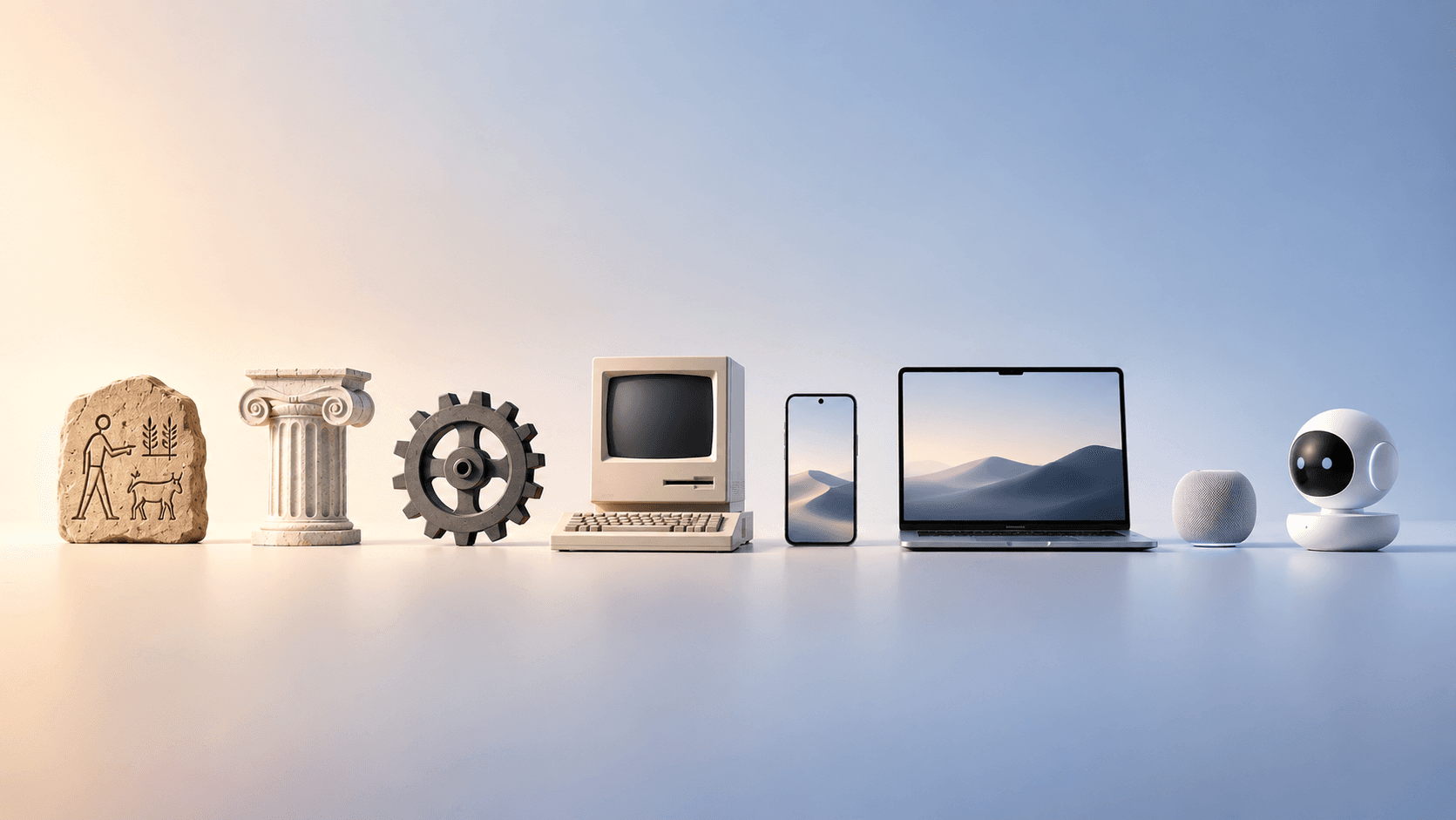
The history of UX design is closely tied to the history of technology. Over the past century, the focus of design has gradually expanded: from physical objects, to interfaces, to interactions, and eventually to complete experiences and connected systems.
From Industrial Design to Human Factors
Long before the term “user experience” became common, designers were already thinking about how people interact with products.
Industrial design and human factors focused on making physical products safer, more efficient, more comfortable, and easier to understand. The shape of a tool, the position of a control, or the way information was presented could all influence how easily someone could perform a task.
These principles established an idea that remains central to UX today: products should adapt to human capabilities and limitations rather than forcing people to adapt to poorly designed systems.
The Rise of Graphical User Interfaces
As computing moved beyond specialized technical environments, the relationship between people and machines began to change.
The development of graphical user interfaces (GUIs), particularly from the 1970s onward, introduced visual elements such as windows, icons, menus, and pointers. These interfaces made computers more approachable by giving people familiar visual concepts through which to interact with digital systems.
The focus of design was no longer limited to the physical device. The interface itself had become a fundamental part of the experience.
The Web and the Birth of Digital UX
The arrival of the web in the 1990s brought another major shift.
Websites quickly became products and services in their own right. Designers had to think about navigation, information architecture, content, accessibility, page structure, and increasingly complex user journeys.
UX began to move beyond individual interactions. The question was no longer simply, “Can someone use this interface?” It became, “Can someone understand this experience and accomplish what they came here to do?”
Mobile and the Era of Responsive Experiences
The rise of smartphones and touchscreens changed UX once again.
Designers had to account for smaller screens, touch interactions, different contexts of use, and a growing range of devices and environments. Responsive and adaptive design became essential as people moved between phones, tablets, desktops, and other connected devices.
The shift also changed user expectations. Digital experiences became more immediate, personal, and context-dependent.
From Interfaces to Intelligent Systems
Today, UX is expanding beyond traditional screens and predefined interactions.
Artificial intelligence and machine learning have introduced systems that can predict, recommend, generate, summarize, and adapt to users. Instead of always navigating through a fixed sequence of screens, people can increasingly express an intention and let the system determine how to help them achieve it.
This changes the role of the interface itself.
UX design is moving from designing individual screens and interactions toward designing relationships between people, technology, data, and intelligent systems.
The evolution is not simply about making interfaces more sophisticated. It is about making technology better aligned with human goals, context, and expectations.
UX Design Trends Shaping 2026
As UX has evolved from physical products to digital interfaces and intelligent systems, the questions designers face have evolved with it.
Today, some of the most important shifts in UX are not visual trends at all. They are changes in how people interact with technology and how designers think about the role of the interface.
1. AI-Native and Adaptive Experiences
Artificial intelligence is moving beyond personalization and recommendation systems. It is increasingly becoming part of the interaction model itself.
AI-powered products can help people search, summarize information, generate content, explore options, and complete multi-step tasks. This creates new UX questions: How should users express their intent? How should a system communicate uncertainty? When should automation take over, and when should the user remain in control?
Designing for AI is therefore not simply about adding an AI feature to an existing product. It often means rethinking the interaction model around capabilities such as conversation, prediction, generation, and automation.
2. Designing for AI Agents
Another emerging shift is the rise of AI agents that can perform tasks on behalf of people.
Traditionally, interfaces have been designed primarily for human users. Increasingly, software agents may search, compare, navigate, purchase, communicate, or interact with other systems on a user’s behalf.
This creates a new design challenge: experiences may need to work both for people and for the intelligent systems acting on their behalf.
UX designers will need to think carefully about permissions, transparency, system status, error recovery, and ways for people to understand and control what an agent is doing.
3. Multimodal and Context-Aware Interactions
Digital interaction is no longer limited to clicking, tapping, and typing.
Voice, text, images, gestures, cameras, sensors, and other input methods are increasingly being combined to create more flexible interactions. The best experience may depend less on a single interface and more on choosing the right mode of interaction for a particular context.
Context also matters more than ever. The device being used, the user’s environment, the task at hand, and the information already available to the system can all influence how an experience should behave.
4. Accessibility and Neuroinclusive Design
Accessibility is increasingly treated as a fundamental part of product quality rather than something added at the end of the design process.
UX teams are paying greater attention to different physical, sensory, cognitive, and neurological needs. Clear information architecture, understandable language, predictable interactions, sufficient contrast, flexible controls, and reduced cognitive load can make products more usable for a much wider range of people.
Inclusive design often benefits everyone. An experience designed to be clearer and easier to navigate for people with specific needs can also be faster and more intuitive for users in general.
5. Trust, Transparency, and Human Control
As digital products become more automated and intelligent, trust becomes an increasingly important part of UX.
People need to understand what a system is doing, what information it is using, and when they can intervene. This becomes particularly important when AI systems make recommendations, generate information, or take actions on a user’s behalf.
Good UX should not hide complexity behind automation. Instead, it should provide the right amount of explanation, feedback, and control at the right moment.
The goal is not to make people understand every technical detail. It is to help them maintain an accurate understanding of the system and feel confident about what will happen next.
6. Designing Beyond the Screen
The boundaries of digital products are becoming less defined.
Wearables, voice interfaces, spatial computing, connected devices, and other emerging technologies are creating experiences that extend across multiple touchpoints.
This means UX design increasingly requires thinking about relationships between devices and services rather than designing isolated screens.
The challenge is to create a coherent experience even when an interaction moves from one device, environment, or moment to another.
The Future of UX Design
The future of UX is unlikely to be defined by a single technology or visual style. Instead, the field will continue to evolve as designers work with increasingly capable systems and increasingly complex user expectations.
From Interfaces to Systems
UX designers will increasingly work beyond individual screens and features.
Products are becoming ecosystems of interfaces, services, data, devices, and automated processes. Designing a good experience therefore requires understanding how these parts connect and how an interaction in one part of the system affects another.
From Tasks to Intent
Traditional interfaces often require people to understand how a system works before they can accomplish something.
As conversational and intelligent interfaces become more capable, people can increasingly express what they want rather than manually navigating every step required to get there.
This does not mean traditional interfaces will disappear. Instead, effective products may combine direct manipulation with conversational and automated interactions, allowing people to choose the level of control that suits the task.
From Automation to Augmentation
The future of UX is not necessarily about removing humans from the process.
In many situations, the most valuable role for technology is to help people understand information, explore possibilities, reduce repetitive work, and make better decisions — while leaving meaningful judgment and control with the user.
This makes the designer’s role increasingly important. As technology becomes capable of generating interfaces, content, and solutions, human judgment becomes more valuable in deciding what should be built, why it matters, and whether it genuinely improves people’s lives.
Designing for Trust and Inclusion
As digital experiences become more intelligent and interconnected, trust, accessibility, privacy, transparency, and inclusion will become increasingly central to UX design.
The future of UX will therefore not simply be about creating faster or more advanced technology. It will be about making increasingly complex systems understandable, useful, and respectful of the people who depend on them.
Conclusion
The evolution of UX is ultimately a story about the changing relationship between people and technology.
We have moved from designing physical objects to designing graphical interfaces, from interfaces to digital experiences, and from individual experiences toward intelligent and connected systems.
Yet the fundamental principle has remained remarkably consistent: technology should work for people.
As new technologies change what products can do, UX design will continue to evolve with them. The challenge for designers will not simply be to adopt every new technology, but to decide where it genuinely improves an experience and where simplicity, clarity, human judgment, and control matter more.
The future of UX is therefore not just about designing what comes next. It is about designing technology that remains useful, understandable, and human as what comes next continues to change.