Why Do So Many Banking Apps Feel the Same?
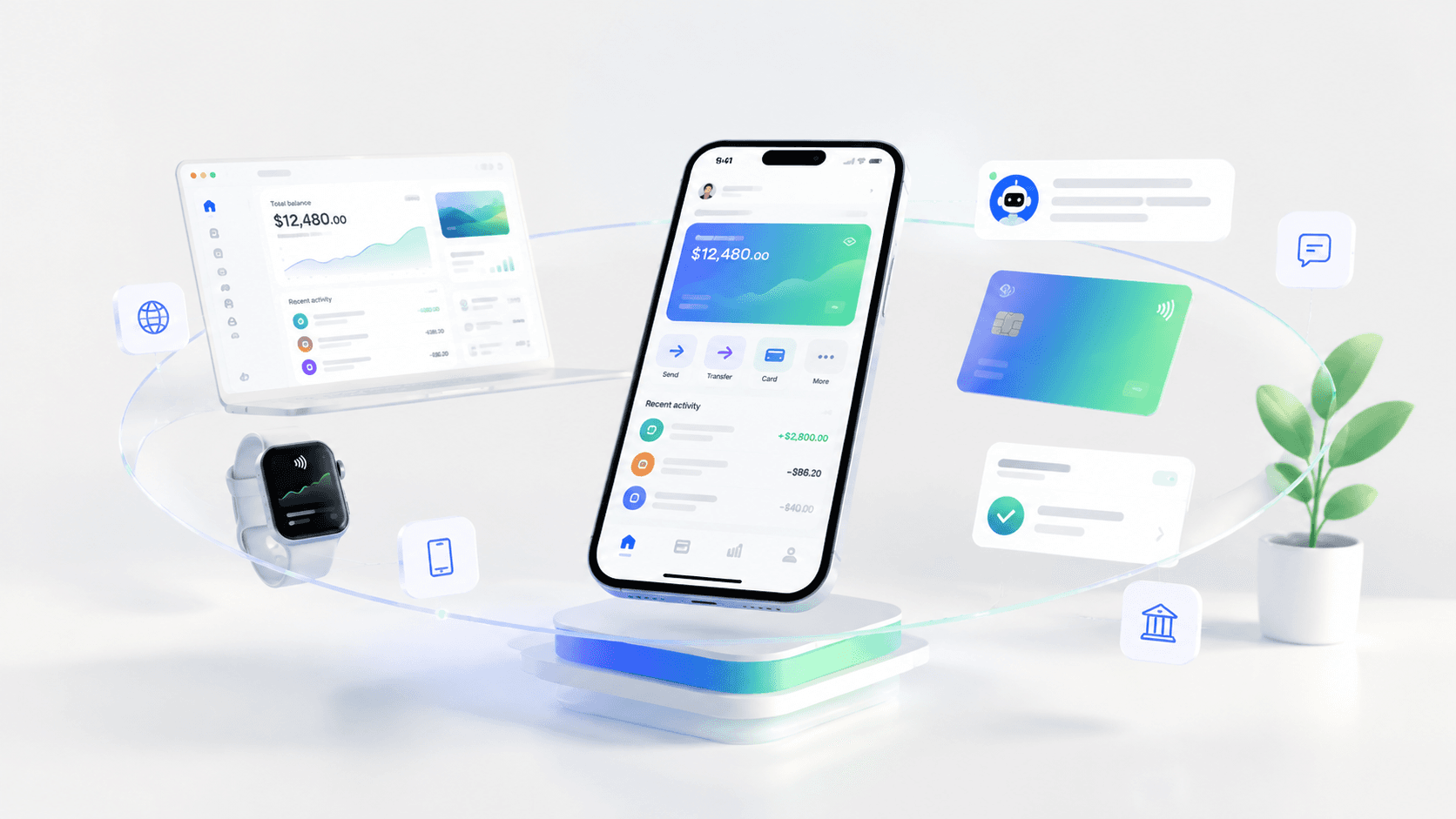
Open ten banking apps on your phone. Look at their onboarding flows, dashboards, payment screens, and account pages.
Can you immediately recognize which one belongs to which bank?
For many users, the answer is no.
The banking industry has achieved something remarkable: financial products can now be launched faster than ever. White-label banking platforms, Banking-as-a-Service (BaaS), and modular financial infrastructures allow institutions to offer digital banking experiences without building every layer from scratch.
This approach reduces development time, lowers technical complexity, and helps organizations enter digital markets faster. White-label models have become an important part of modern financial ecosystems.
But speed creates a new challenge.
When multiple banks use similar platforms, similar components, and similar customer journeys, the technology advantage can quickly become a differentiation problem.
A bank may have a modern mobile app, secure infrastructure, and dozens of financial features — yet customers may still experience it as another generic banking product.
The question is no longer only:
“Can we launch a digital banking product?”
The more important question is:
“Can we create a banking experience that customers recognize, trust, and remember?”
This is where White-Label Banking UX becomes a strategic business decision, not just a design challenge.
A successful digital banking experience is built by connecting three elements:
- The reliability of financial infrastructure
- The flexibility of a white-label platform
- A digital experience layer that reflects the brand, customer needs, and business strategy
In this article, we explore how banks and fintech companies can move beyond simple customization and build digital experiences that feel truly their own.
What Technology Stack Is Behind a White-Label Banking App?
To understand why many digital banking products look and feel similar, we first need to understand how they are built.
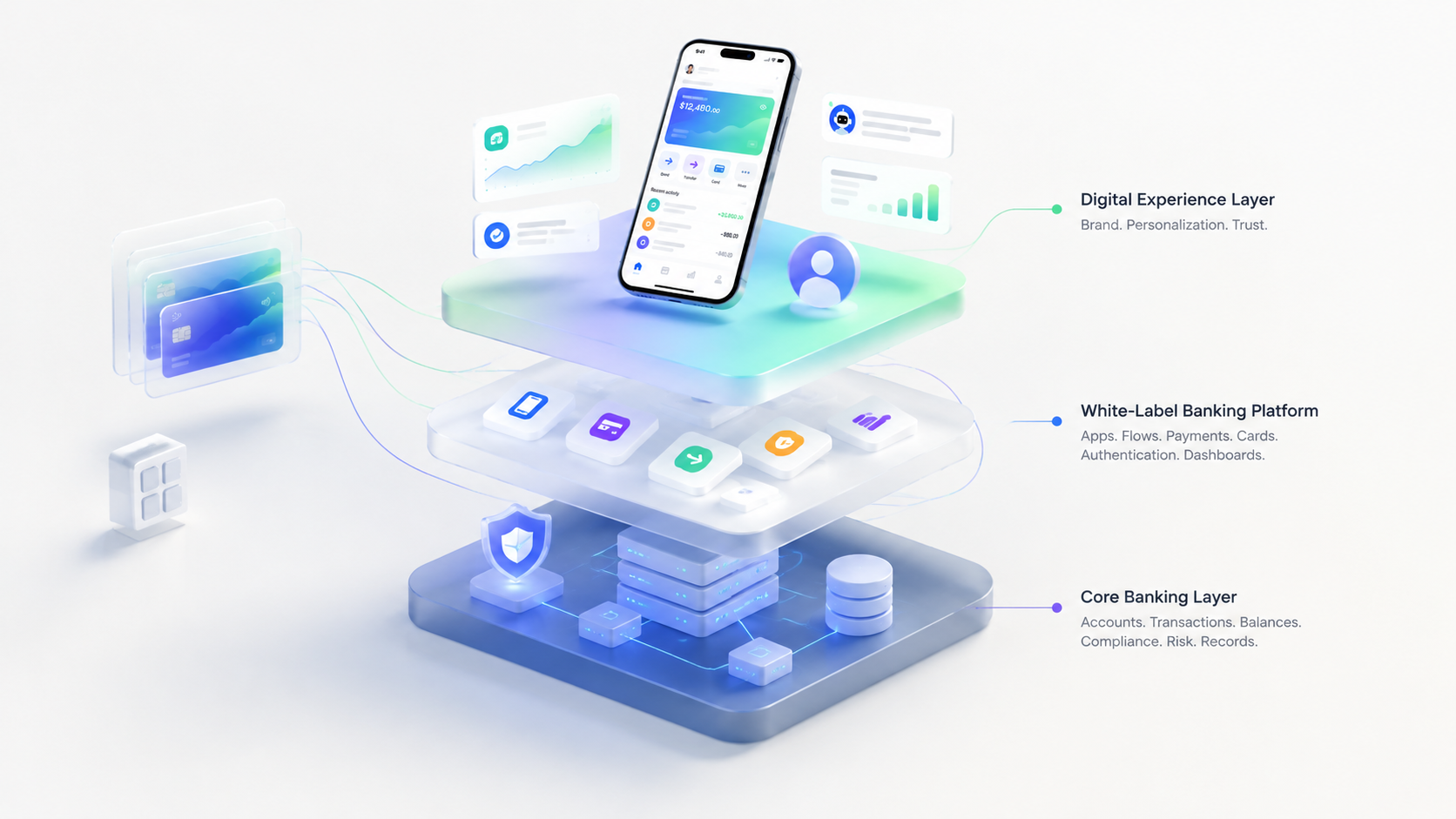
Most modern banking applications are not created as a single system. They are usually built through multiple layers, each responsible for a different part of the customer experience.
1. Core Banking Layer
At the foundation is the Core Banking System.
This layer manages the financial logic behind the product:
- Customer accounts
- Transactions
- Balances
- Compliance requirements
- Risk management
- Financial records
It is the most critical layer for reliability and security, but customers rarely interact with it directly.
A customer does not see the core banking system when checking their balance or transferring money. They only experience the result through the digital interface.
2. White-Label Banking Platform
The second layer is the White-Label Banking Platform.
This provides reusable digital capabilities such as:
- Mobile banking applications
- Account management flows
- Payment journeys
- Cards and transfers
- Authentication processes
- Financial dashboards
For many organizations, this layer solves the hardest technical challenge: launching a digital product quickly.
However, the platform itself does not automatically create differentiation.
A white-label solution can provide the foundation, but the foundation is not the final experience.
3. Digital Experience Layer
The third layer is where customer perception is created.
The Digital Experience Layer defines how the product feels and behaves:
- Information architecture
- User journeys
- Interaction patterns
- Content and microcopy
- Personalization
- Visual language
- Brand expression
This is the layer where trust is built.
A banking app is not only a tool for completing transactions. It is a continuous conversation between the customer and the financial brand.
A confusing payment flow creates uncertainty.
A clear onboarding experience creates confidence.
A personalized dashboard creates relevance.
The difference between a functional banking app and a memorable banking experience is often created in this layer.
Why Do White-Label Banking Products Struggle to Stand Out?
White-label technology solves one major problem:
How to launch faster.
But it can create another challenge:
How do you avoid looking like everyone else?
Many organizations approach customization from a visual perspective.
They change:
- Logo
- Colors
- Typography
- Basic branding elements
But customers do not experience a bank only through visual identity.
They experience it through decisions, interactions, and moments of trust.
A customer does not remember a banking app because it uses a specific shade of blue.
They remember:
- How easy it was to open an account
- Whether financial information was understandable
- Whether the app helped them make better decisions
- Whether problems were resolved smoothly
This difference can be described as the gap between brand identity and experience identity.
Brand identity is what a company says about itself.
Experience identity is what customers actually feel when interacting with the product.
A white-label banking platform can carry a brand logo, but without thoughtful UX decisions, the experience may still feel generic.
The strongest digital banking products do not simply apply a brand on top of existing technology.
They translate the brand strategy into every customer interaction.
For example:
A premium investment-focused bank should not only have premium colors.
Its experience should communicate confidence through:
- Clear financial explanations
- Calm decision-making flows
- Intelligent recommendations
- Transparent risk communication
A bank focused on younger customers should not only use modern visuals.
Its experience should support:
- Faster onboarding
- Simple financial education
- Flexible money management
- Personalized interactions
The real competitive advantage is not owning a different interface.
It is creating a different relationship with customers.
Why Is the Digital Experience Layer a Business Priority?
For many organizations, UX is still considered a product execution task.
Something that happens after technology decisions are made.
But in digital banking, experience decisions directly influence business outcomes.
A customer who cannot understand a feature will not use it.
A customer who cannot complete onboarding will never reach the product value.
A customer who does not trust the interface will hesitate before making financial decisions.
Digital experience affects:
Product Adoption
Banks often invest heavily in launching new capabilities:
- Investments
- Loans
- Insurance
- Financial planning tools
- Rewards
But adding features does not guarantee adoption.
The customer must understand:
- Why the feature exists
- How it benefits them
- What action they should take next
Good UX connects business capabilities with customer needs.
Customer Retention
Switching banks is easier than ever.
The mobile experience often becomes the main relationship between customers and financial brands.
When the experience feels simple, predictable, and personalized, customers are more likely to continue using the product.
Brand Differentiation
Traditional competitive advantages in banking, such as physical branches or product availability, are becoming less visible in digital environments.
The app increasingly becomes a brand.
As mobile channels become central to financial interactions, digital experience plays a larger role in customer engagement, perception, and loyalty.
This means UX is no longer only about usability.
It becomes part of business strategy.
Shallow vs. Deep Customization: What Should Banks Change?
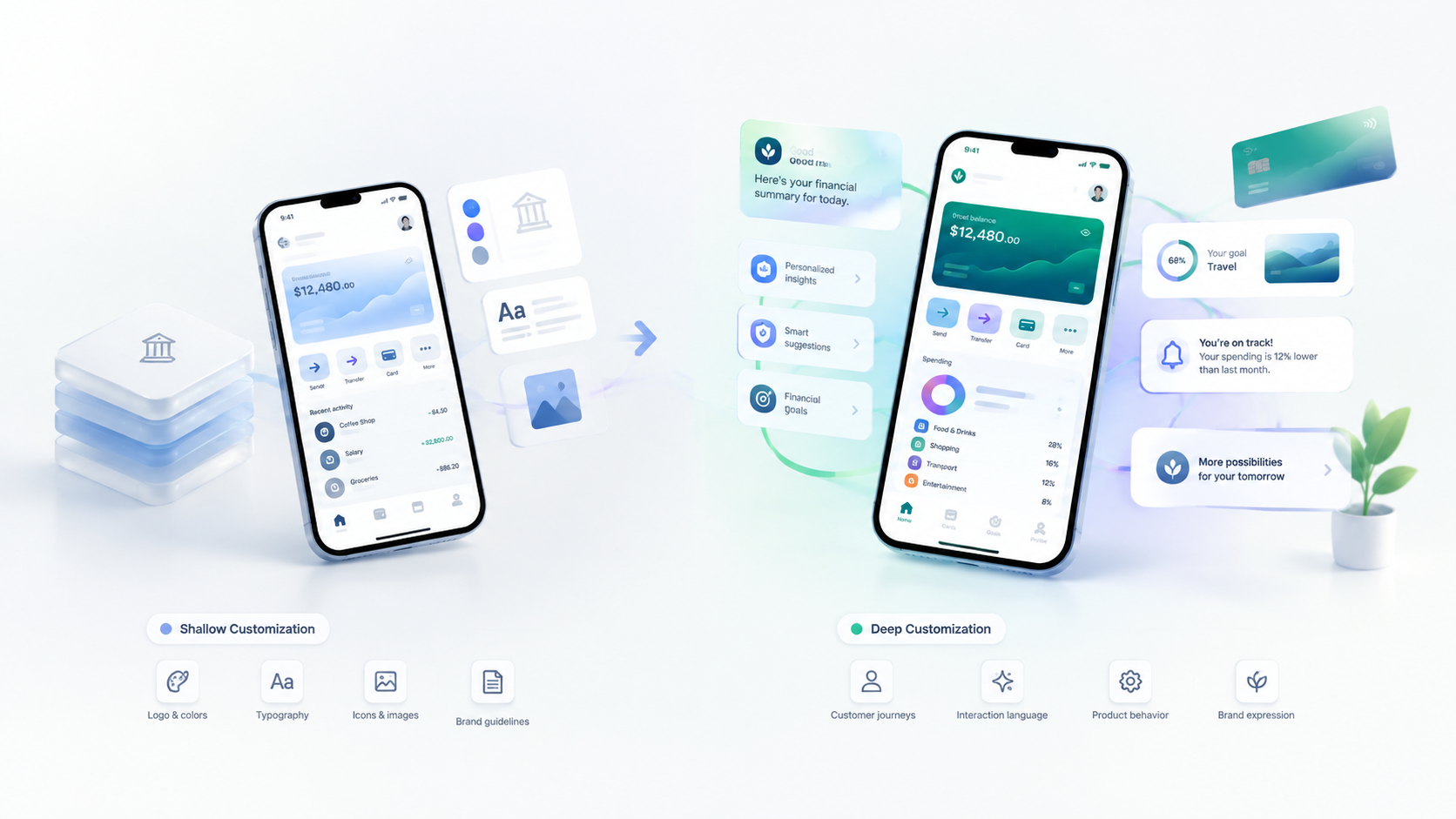
When adopting a white-label banking platform, one of the most important strategic decisions is determining how much of the experience should be customized.
Not every element needs to be rebuilt.
But limiting customization only to visual branding can create a product that technically belongs to a bank while emotionally belonging to nobody.
The difference is between shallow customization and deep customization.
| Shallow Customization | Deep Customization |
|---|---|
| Changing logo and colors | Redesigning customer journeys around business goals |
| Adjusting typography | Creating a unique interaction language |
| Replacing icons and images | Improving onboarding, payments, and financial decisions |
| Applying brand guidelines | Translating brand values into product behavior |
| Cosmetic differentiation | Experience-level differentiation |
Shallow customization is useful for launching quickly.
A financial institution may need to enter a market within months rather than years.
In that situation, using existing components and proven patterns can reduce risk.
However, over time, the limitations become visible.
Customers do not compare banking apps based only on appearance.
They compare them based on how effectively each product helps them complete important financial tasks.
Deep customization focuses on questions such as:
- Who are our customers and what financial problems do they have?
- Which moments create trust or frustration?
- Which features support our business strategy?
- How should the product communicate our brand personality?
- Where can experience design create competitive advantage?
For example, two banks may use the same white-label infrastructure.
One may create a traditional banking experience focused on transactions:
Check balance → Transfer money → View statement
Another may create a financial companion:
Understand spending → Receive guidance → Discover opportunities → Make better decisions
The technology foundation may be similar.
The customer relationship is not.
The goal of deep customization is not to customize everything.
It is to identify the moments where experience creates business value.
What Should Banks Get Right Before Launch?
Launching a digital banking product is not only a technology challenge.
Many products fail not because the infrastructure is unstable, but because the experience does not solve real customer problems.
Before launch, banks and fintech companies should focus on four priorities.
1. Understand Customer Behavior Before Designing Solutions
Financial products are built around sensitive decisions.
Customers think carefully before:
- Opening an account
- Moving money
- Investing
- Applying for credit
- Sharing personal information
Assumptions are dangerous.
Before designing experiences, teams should understand:
- Customer goals
- Existing financial habits
- Pain points
- Trust barriers
- Decision-making patterns
Research helps organizations avoid building features that customers technically can use but do not actually need.
2. Design Financial Journeys, Not Individual Screens
A common mistake is focusing on isolated screens:
- Dashboard design
- Payment screen
- Investment page
- Profile section
But customers experience banking as a journey.
For example, investing is not just a “buy fund” button.
The complete journey includes:
- Discovering investment opportunities
- Understanding risks
- Comparing options
- Building confidence
- Completing the transaction
- Tracking progress
A successful banking experience connects every step.
3. Make Trust Visible During Critical Moments
Trust is the foundation of digital finance.
Users need confidence when they:
- Verify their identity
- Enter financial information
- Authorize payments
- Make investment decisions
Small experience decisions have a major impact:
- Clear explanations reduce uncertainty.
- Transparent feedback improves confidence.
- Simple language makes complex financial products accessible.
Trust is not created only through security technology.
It is also created through every interaction that helps users feel informed and in control.
4. Build for Scale From the Beginning
Many banking products launch with limited functionality but eventually expand into broader ecosystems:
- Payments
- Investments
- Lending
- Insurance
- Personal finance management
The experience architecture must support growth.
A scalable design approach helps teams introduce new capabilities without creating inconsistent journeys.
This is where UX strategy, design systems, and product thinking become important—not as visual tools, but as foundations for long-term product evolution.
For organizations evaluating their current experience maturity, a structured UX Audit can reveal usability issues, customer friction points, and opportunities for improvement before they become expensive product problems.
What Common Mistakes Hold White-Label Banking Products Back?
Even well-funded digital banking initiatives can struggle because of several recurring mistakes.
1. Adding More Features Instead of Creating More Value
Financial products often compete through feature quantity.
More cards.
More dashboards.
More investment options.
More services.
But complexity does not automatically create value.
Customers do not need more features.
They need better decisions.
A successful product helps users understand what matters and guides them toward meaningful actions.
2. Treating UX as a Final Design Phase
One of the most expensive mistakes is involving UX teams only after technical decisions have already been made.
By that stage, important questions may already be fixed:
- Platform limitations
- User flows
- Data structures
- Product assumptions
Experience should influence product strategy from the beginning.
Not decorate the final output.
3. Designing Without Real Customer Feedback
Financial teams often have strong internal knowledge.
But internal knowledge is not the same as customer understanding.
Users may:
- Misunderstand terminology
- Avoid certain features
- Abandon onboarding
- Feel uncertain about financial decisions
Continuous research and behavioral data help teams design based on reality rather than assumptions.
4. Ignoring Emotional Experience
Banking has traditionally focused on accuracy and security.
Those remain essential.
But digital customers also expect:
- Clarity
- Confidence
- Personal relevance
- Guidance
The future of banking experience is not only transactional.
It is relational.
What Comes Next in Digital Banking Experience?
The next generation of digital banking will not be defined only by faster transactions or more financial products.
It will be defined by how intelligently products understand and support customers.
Several trends are shaping this future.
AI-Powered Financial Assistance
Artificial intelligence in Fintech is moving banking experiences from reactive tools toward proactive assistance.
Instead of waiting for customers to search:
“Where did my money go?”
Future experiences may identify patterns, explain financial behavior, and provide personalized recommendations.
The important challenge is not adding AI features.
It is designing trustworthy interactions between customers and intelligent systems.
Advanced Personalization
Personalization will move beyond showing different content.
Future banking products may adapt:
- Information priorities
- Recommendations
- Financial guidance
- User journeys
based on individual goals and behaviors.
However, personalization must remain transparent.
Customers should understand why they receive recommendations and maintain control over their financial choices.
Continuous Experiences Across Channels
Customers no longer think in terms of separate channels.
They expect continuity between:
- Mobile apps
- Websites
- Customer support
- Physical interactions
- Digital advisors
The strongest financial experiences will create one consistent relationship across every touchpoint.
Building Better Banking Experiences with youx Studio
White-label technology has changed how quickly financial products can enter the market.
But speed alone does not create competitive advantage.
The future belongs to organizations that combine strong financial infrastructure with meaningful customer experiences.
A successful banking product is not defined only by the technology behind it.
It is defined by how confidently customers can use it, understand it, and build a relationship with the brand.
At youx, we help fintech companies and financial institutions design digital experiences that connect business strategy, customer needs, and scalable product design.
From UX research and experience strategy to digital banking design and product systems, our focus is creating financial products that feel clear, trustworthy, and genuinely different.
Because in a market where many products can share the same technology foundation, the experience is what makes a brand recognizable.
Build a banking experience that feels like your brand.