
AI is changing fintech UX from interfaces that simply display financial information into experiences that can interpret data, surface insights, and support better decisions. This article explores how AI is reshaping personalization, financial insights, intelligent assistants, and automation while keeping meaningful user control at the center
AI is changing what financial products can do.
For years, digital banking and fintech products have mainly helped users access information and complete predefined tasks: checking a balance, reviewing transactions, transferring money, paying a bill, or managing a card.
AI changes that relationship.
A financial product can now identify patterns in spending, summarize financial activity, answer questions in natural language, detect unusual behavior, predict possible outcomes, and recommend what a user might do next.
But adding AI to a fintech product is not simply a matter of adding a chatbot or another intelligent feature.
The deeper change is in the user experience.
When a product can understand context, interpret data, make recommendations, and potentially take action, the role of UX shifts from designing interfaces that expose functionality to designing experiences that help people understand, decide, and act.
That creates a new product-design question:
What should a financial product do when it can understand more than the user explicitly asks it to?
The answer requires more than AI capability. It requires thoughtful product and UX decisions about context, personalization, automation, uncertainty, and human control.
From Digital Interfaces to Intelligent Financial Experiences
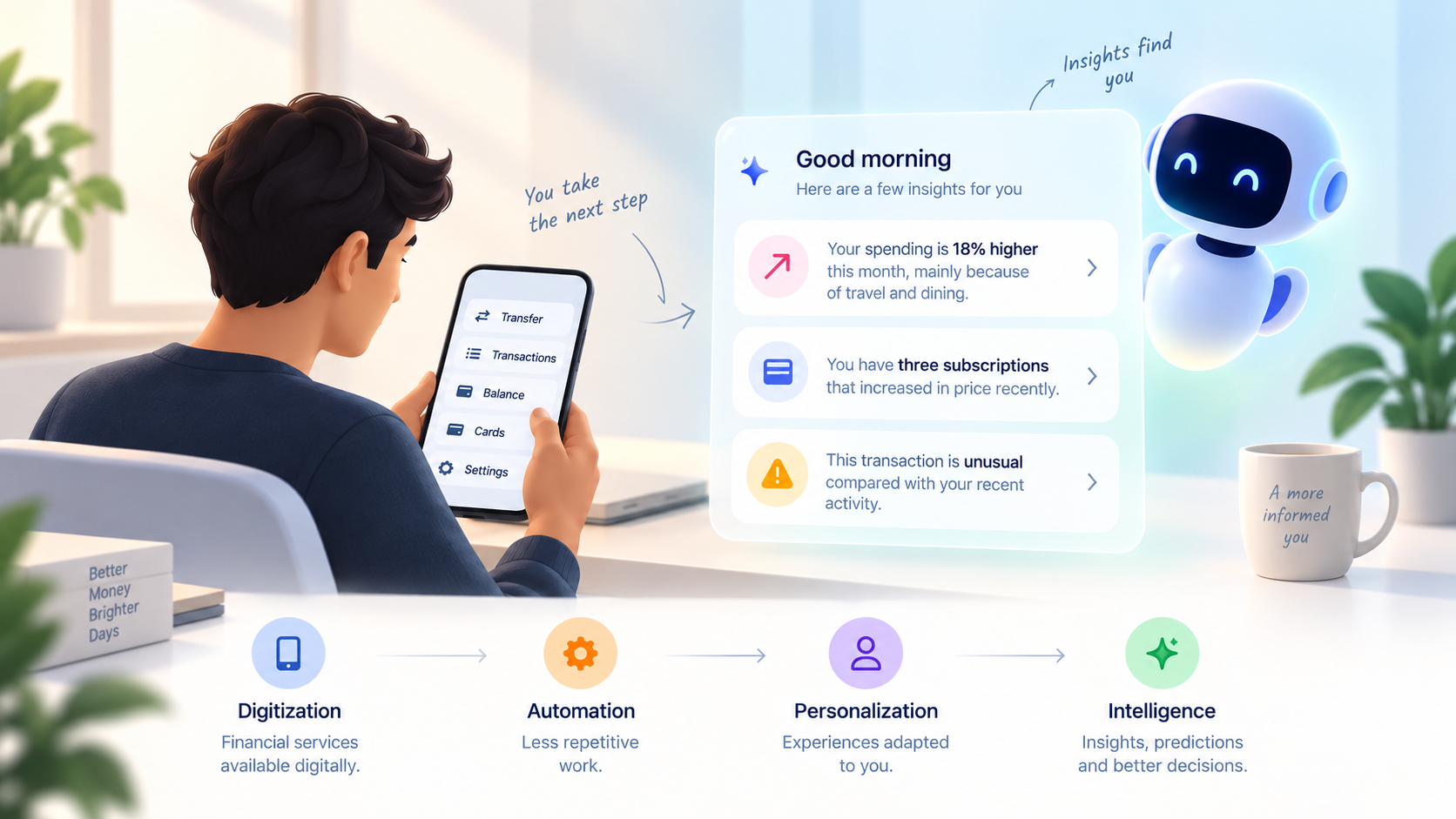
Traditional financial products are largely built around predefined workflows.
A user wants to transfer money, so they open the transfer flow.
They want to understand their spending, so they open their transaction history.
They want to check their balance, so they look at the account overview.
The product responds to explicit user actions.
AI makes another type of interaction possible.
Instead of waiting for the user to navigate through several screens, the product can interpret information and surface something relevant:
Your spending is 18% higher this month, mainly because of travel and dining.
Or:
You have three subscriptions that increased in price recently.
Or:
This transaction is unusual compared with your recent activity.
The product is no longer just presenting financial information.
It is interpreting it.
This creates a progression:
Digitization → Automation → Personalization → Intelligence
Digitization makes financial services available digitally.
Automation reduces repetitive work.
Personalization adapts experiences to individual users.
Intelligence allows the product to interpret context, generate insights, make predictions, and support decisions.
The UX challenge changes at every stage.
With a conventional interface, the designer asks:
“How can the user complete this task?”
With an intelligent interface, the questions become:
“What does the user need to understand?”
“What can the system do proactively?”
“When should it make a recommendation?”
“When should it stay out of the way?”
That is where AI in fintech UX becomes more than a technology problem.
Where AI Changes Fintech UX
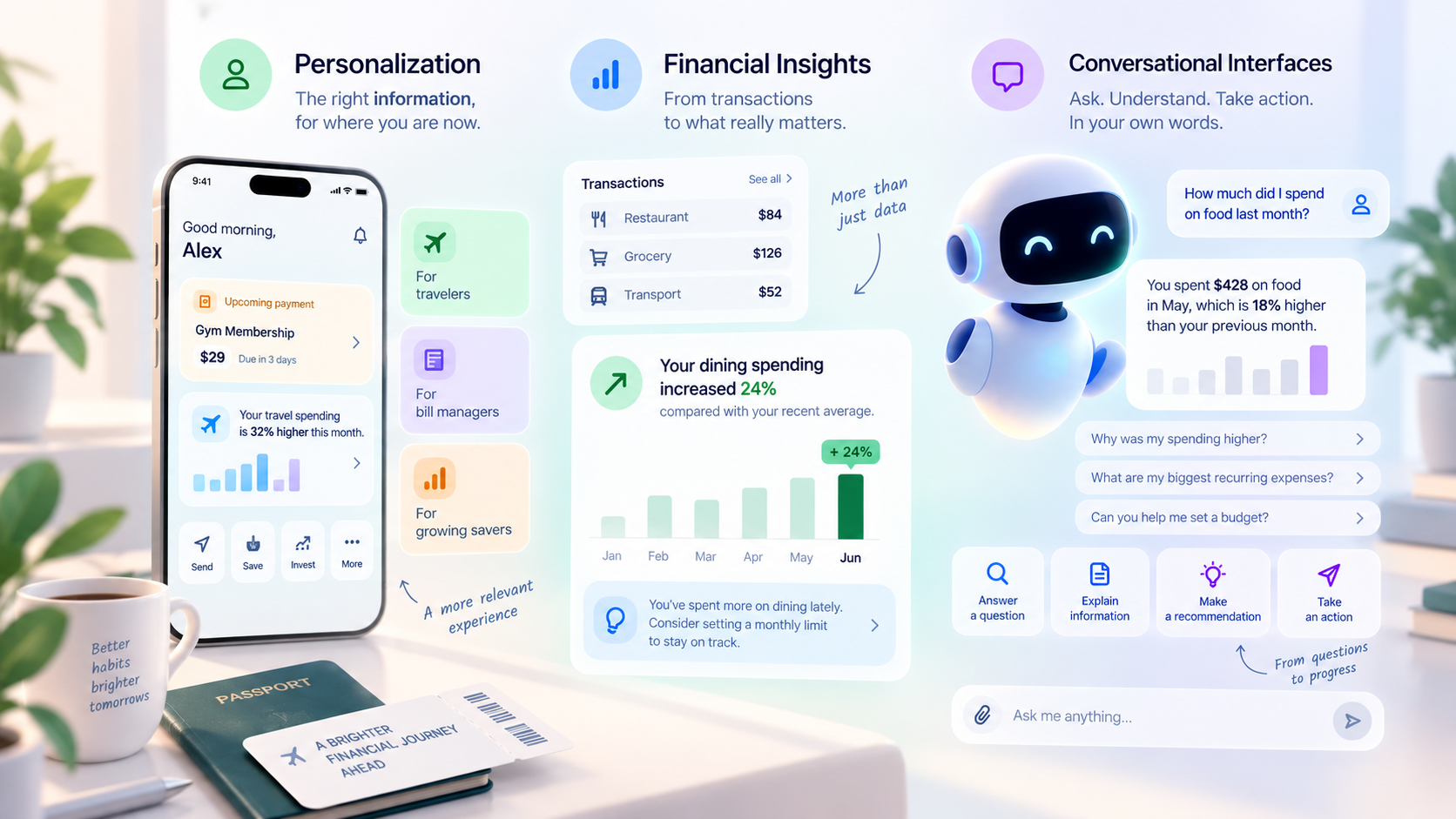
AI can influence almost every part of a financial product, but some areas are particularly significant.
Personalization
Financial products have access to large amounts of behavioral and transactional data.
AI can use that context to make experiences more relevant.
Instead of showing every user the same dashboard, the product might prioritize information based on their current financial situation.
A user who regularly travels might see travel-related spending insights. Someone managing recurring bills might benefit from upcoming-payment reminders. Someone whose spending has changed significantly might receive a contextual explanation.
But personalization should not mean showing users everything the system knows about them.
The best personalization reduces cognitive load.
The product should become more relevant, not more complicated.
Financial Insights
One of the clearest opportunities for AI is turning financial data into understandable insights.
Most financial products already have plenty of data.
The problem is that raw data does not automatically create understanding.
A transaction list might tell a user:
Restaurant — $84
Grocery — $126
Transport — $52
AI can potentially identify a broader pattern:
Your dining spending increased 24% compared with your recent average.
This moves the experience from:
Data → Information → Insight
The UX challenge is deciding which insights deserve attention.
An intelligent product should not simply generate more observations. It should identify information that is relevant, understandable, and potentially useful for action.
Conversational Interfaces
Natural-language interaction creates another major shift.
Instead of navigating through several screens, a user might ask:
“How much did I spend on food last month?”
Or:
“Why was my spending higher this month?”
Or:
“What are my biggest recurring expenses?”
A financial AI assistant can make complex information easier to access.
But conversational UX also introduces a different challenge: users may not know exactly what the system can do.
A good financial AI assistant therefore needs clear boundaries.
The experience should distinguish between:
Answering a question
Explaining information
Making a recommendation
Taking an action
These are increasingly consequential levels of interaction.
An assistant explaining a transaction is very different from an assistant moving money.
From Data to Insight
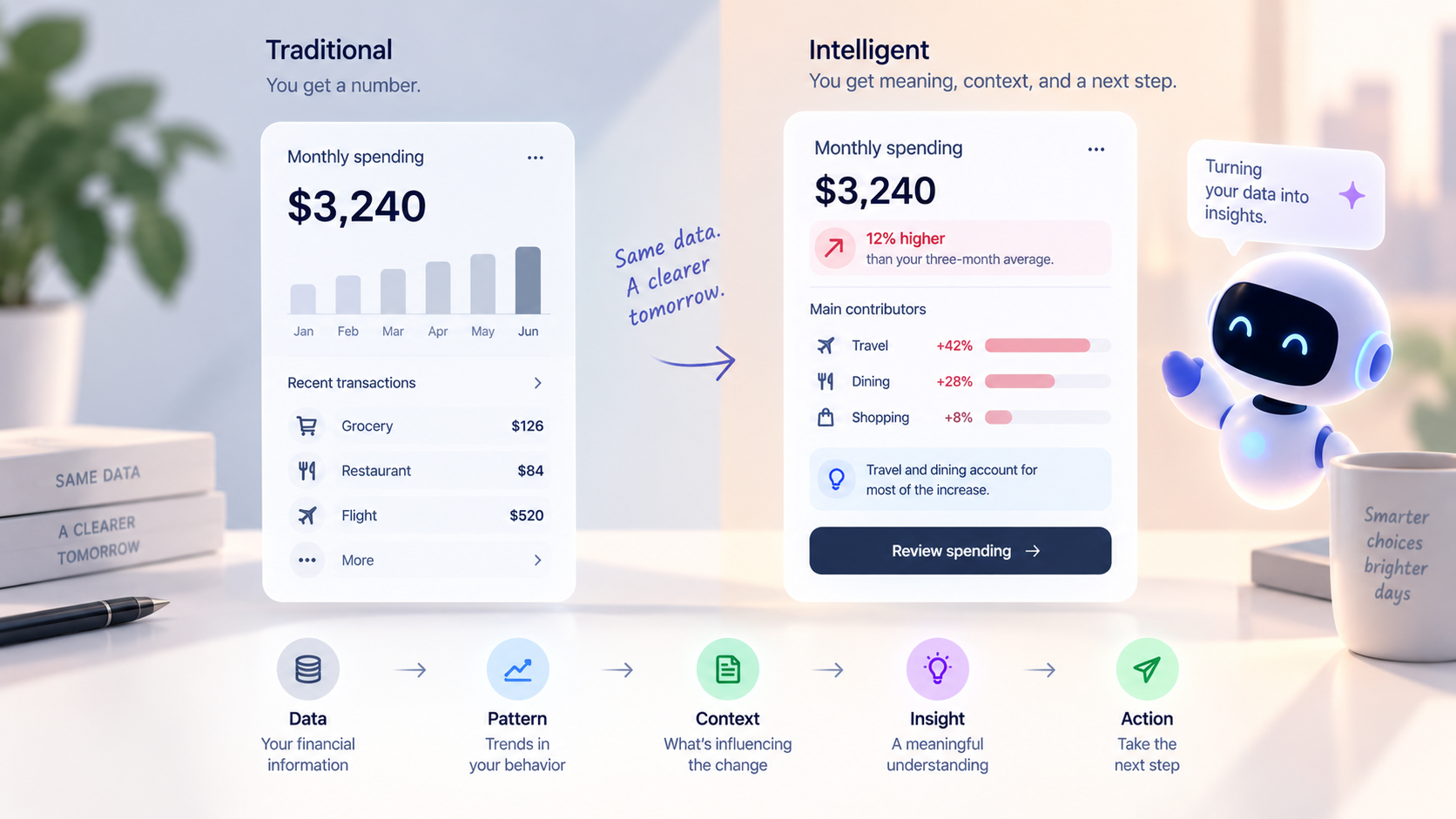
The real opportunity in AI-powered fintech is not simply generating more financial information.
It is helping users understand what that information means.
Consider the difference between these two experiences.
Traditional
Monthly spending: $3,240
The user receives a number.
Intelligent
Monthly spending: $3,240
12% higher than your three-month average.
Travel and dining account for most of the increase.
Now the product is helping the user interpret the number.
The next step could be:
Review spending
This creates a much more useful sequence:
Data → Pattern → Context → Insight → Action
AI can be particularly valuable in the middle of this sequence.
But there is an important design principle here:
AI should reduce the work required to understand financial information, not simply generate more information.
A system that produces dozens of AI-generated insights every week may technically be intelligent while making the product harder to use.
Good fintech UX still requires prioritization.
From Insight to Action
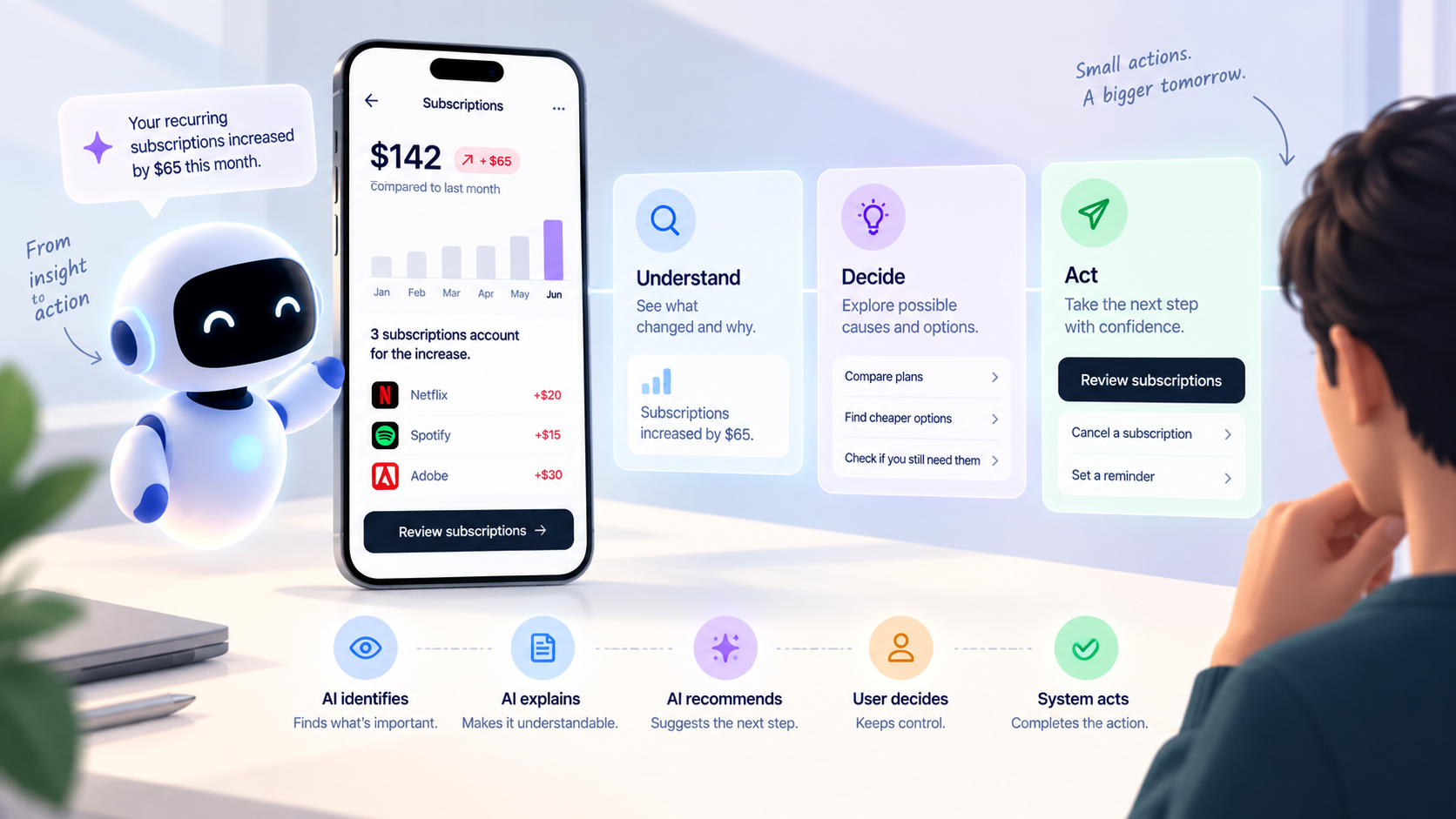
Once AI can interpret financial data, the next opportunity is helping users act on it.
Imagine a product that identifies:
Your recurring subscriptions increased by $65 this month.
That’s useful.
But the experience could continue:
Three subscriptions account for the increase.
And then:
Review subscriptions
The product is moving from information toward action.
This creates another progression:
Understand → Decide → Act
AI can support each stage.
It can explain what happened, identify possible causes, compare options, and recommend a next step.
But the system does not always need to make the final decision.
For many financial workflows, a better model is:
AI identifies → AI explains → AI recommends → User decides → System acts
This keeps intelligence inside the workflow without removing the user’s agency.
Designing AI Financial Assistants
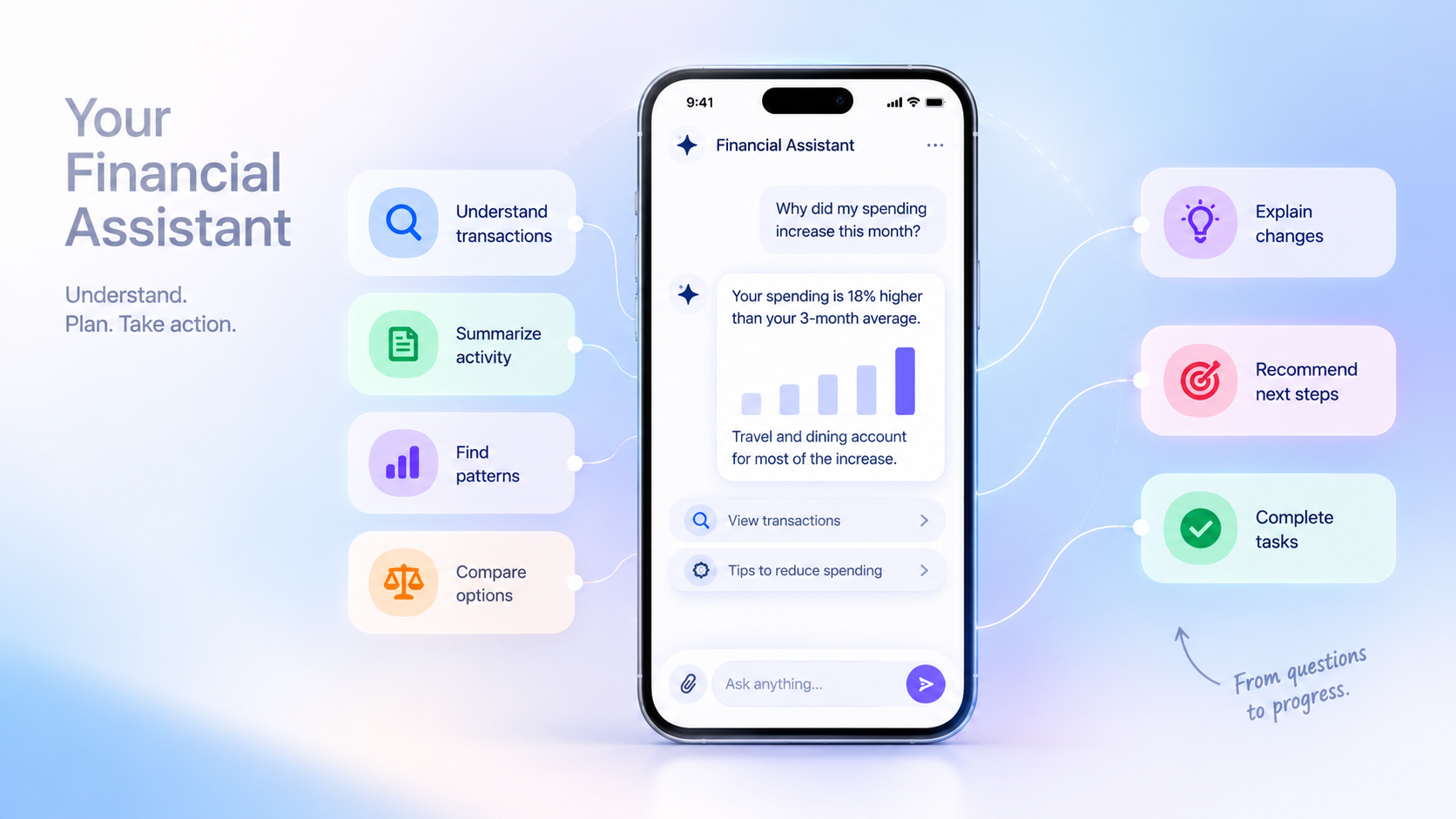
An AI financial assistant should not simply be a chatbot attached to a banking app.
Its value comes from how deeply it understands the product and the user’s financial context.
A useful assistant might help users:
- understand unfamiliar transactions
- summarize financial activity
- find specific information
- identify spending patterns
- explain changes in financial behavior
- compare financial options
- prepare for decisions
- complete routine tasks
But the assistant needs a clear understanding of its own role.
For example:
“What was my spending last month?”
This is primarily an information request.
“Why did my spending increase?”
This requires interpretation.
“How can I reduce my spending?”
This becomes a recommendation problem.
“Move $500 into my savings account.”
This is an action with financial consequences.
Treating all four as the same type of interaction would be a UX mistake.
As the consequence increases, the experience may need more explanation, confirmation, and control.
Designing for AI Uncertainty
AI systems are not always correct.
They can misunderstand context, work with incomplete information, or generate a plausible but incorrect conclusion.
Financial products cannot treat this as a minor interface detail.
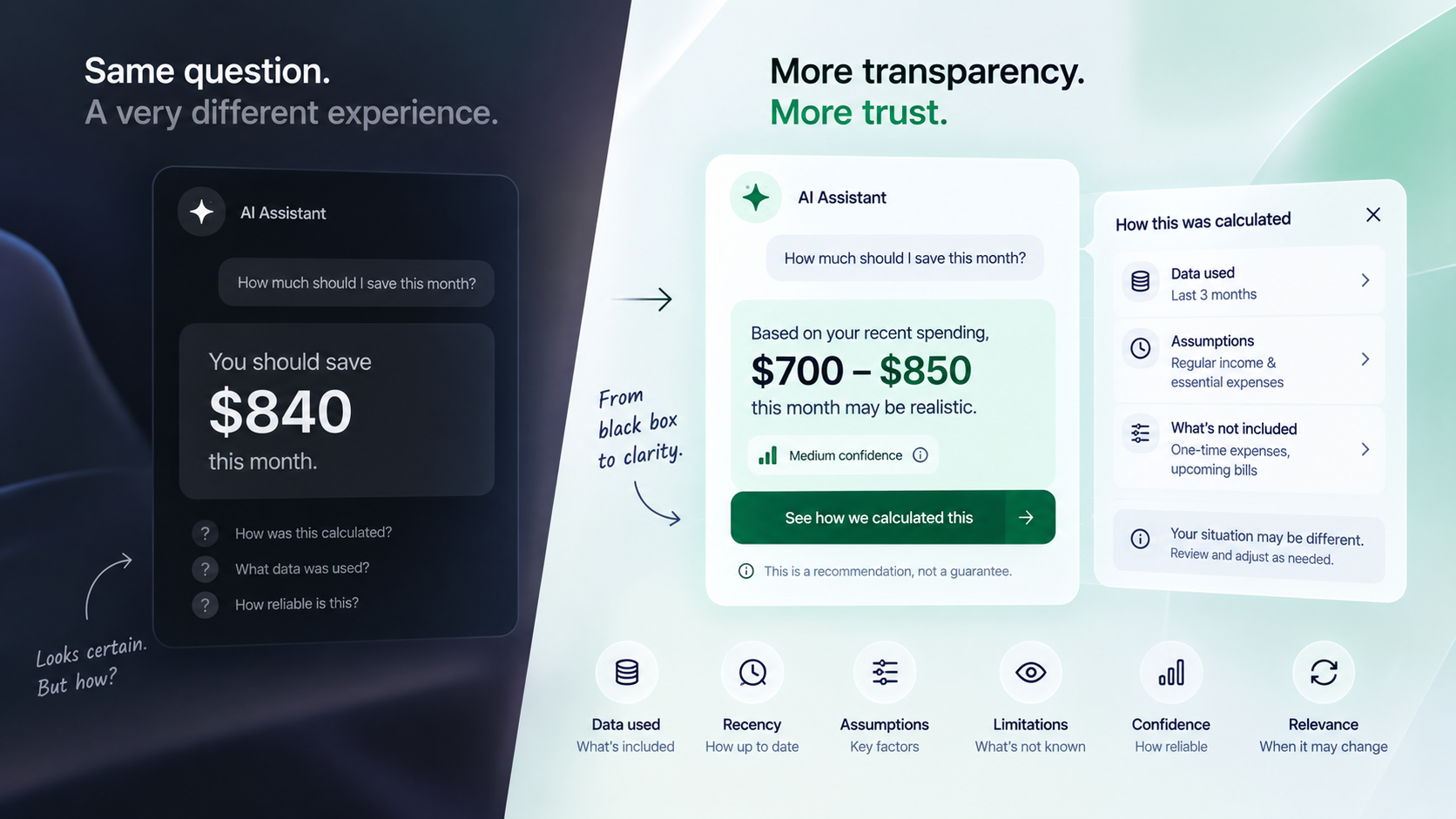
Suppose an AI system says:
You should save $840 this month.
The recommendation sounds precise, but the user cannot tell how the number was calculated or how reliable it is.
A more useful experience might say:
Based on your recent spending, saving around $700–$850 this month may be realistic.
Then provide:
See how we calculated this
The difference is not simply wording.
The second experience communicates that the recommendation is based on assumptions and should be interpreted as guidance rather than certainty.
Depending on the context, users may need to understand:
- what data was used
- how recent the data is
- what assumptions were made
- what the AI does not know
- how confident the system is
- when the recommendation may no longer apply
NIST’s AI Risk Management Framework identifies characteristics such as validity, reliability, transparency, explainability, privacy, and fairness as important considerations for trustworthy AI systems.
The UX principle is simple:
The interface should not appear more certain than the system deserves to be.
Human Control in AI-Powered Finance
Automation is attractive because it can remove repetitive work.
But in financial products, automation needs boundaries.
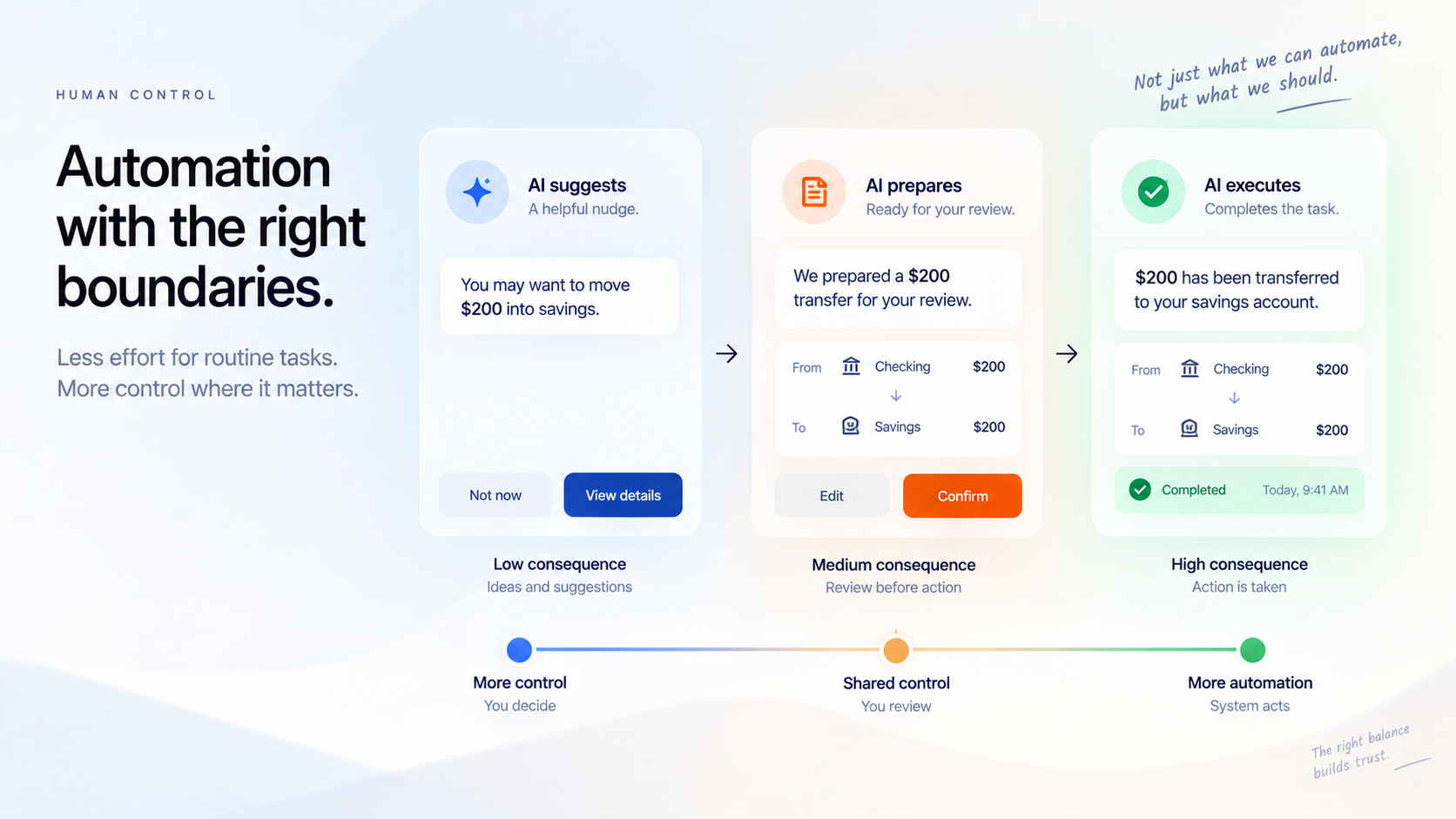
Consider three experiences:
AI suggests
You may want to move $200 into savings.
AI prepares
We prepared a $200 transfer for your review.
AI executes
$200 has been transferred to your savings account.
These are very different experiences.
The right level of automation depends on the consequence, reversibility, and user’s expectations.
Low-risk, repetitive actions can potentially be automated with minimal friction.
High-impact or difficult-to-reverse actions may require explicit confirmation.
This is why AI UX should not be designed around the question:
“What can we automate?”
A better question is:
“What should we automate?”
The distinction is important.
The best AI-powered financial products do not remove users from every decision.
They remove unnecessary effort while preserving meaningful control.
Different AI Use Cases, Different UX Challenges
AI in fintech is not a single use case. Each application creates different product and UX considerations.
An AI financial assistant has to deal with accuracy, context, and escalation. A spending-insight system needs to determine which patterns are actually relevant to the user. Fraud detection needs to account for false positives and help users recover when something is flagged incorrectly.
Credit-related AI introduces questions around explainability and accountability, while personalized financial experiences have to balance relevance with privacy. Automated actions require particularly careful decisions about confirmation, reversibility, and user expectations.
This is why there is no universal AI UX pattern for fintech.
An AI assistant answering a question about a transaction does not need the same interaction model as an AI system influencing a credit decision.
The more consequential the outcome, the more carefully the experience needs to communicate what is happening and what the user can do about it.
A Good AI Experience Knows When to Stop
One of the most overlooked aspects of AI UX is knowing when not to use AI.
Some financial situations require judgment, context, or accountability that an automated system cannot provide effectively.
Consider:
- a disputed transaction
- suspected fraud
- account access problems
- complex credit decisions
- high-value transactions
- sensitive financial circumstances
In these situations, forcing users to continue interacting with an AI assistant can create frustration rather than convenience.
A better experience might look like:
AI understands → AI explains → AI recognizes its limitation → Human takes over
The handoff should also preserve context.
If the user has already explained the problem to the AI, they should not have to repeat the entire story to a human representative.
AI should make the service more capable—not create another barrier between the user and the help they need.
From AI Features to Intelligent Workflows
One of the biggest mistakes teams can make is treating AI as an isolated feature.
Adding an AI chatbot to a banking app does not automatically create an intelligent financial product.
The more interesting opportunity is to integrate intelligence into existing workflows.
Consider a transaction experience.
A traditional flow might be:
Transaction → Details → User interprets
An AI-assisted experience could become:
Transaction → AI identifies unusual pattern → Explanation → User reviews → Action
Or consider personal finance:
Transactions → Categories → Dashboard
versus:
Transactions → Pattern detection → Insight → Recommendation → User action
The difference is not necessarily another screen.
It is the role the product plays in the user’s decision-making process.
This is where AI product design becomes particularly important. The question is no longer just:
“Where can we put AI?”
It becomes:
“Where can intelligence meaningfully improve the user’s workflow?”
For a broader look at how AI product teams can approach research, workflows, risks, and real-world execution, see our guide to AI Product Design: Tools, Workflows, Risks, and Real-World Execution.
Testing AI-Powered Financial Experiences Before Building
AI-powered products introduce assumptions that are often difficult to validate through conventional feature planning.
Will users trust an AI-generated insight enough to act on it? Will they understand why a recommendation was made? Is the problem important enough for them to change their behavior? Does the AI actually reduce effort, or does it introduce another layer of complexity?
These questions can often be tested before building the full product.
A prototype can help test an AI interaction. A realistic workflow can reveal whether users understand the system’s role. A small experiment can show whether a particular insight or recommendation creates meaningful behavior.
This is especially valuable because AI products can involve significant technical investment.
Before building the entire system, teams can identify their riskiest assumptions and test them with the smallest credible experiment.
Our guide to MVP Validation: How to Test Your Product Before You Build It explores this approach in more detail.
The principle is straightforward:
Learn what matters before building what is expensive to change.
A UX Framework for AI-Powered Fintech
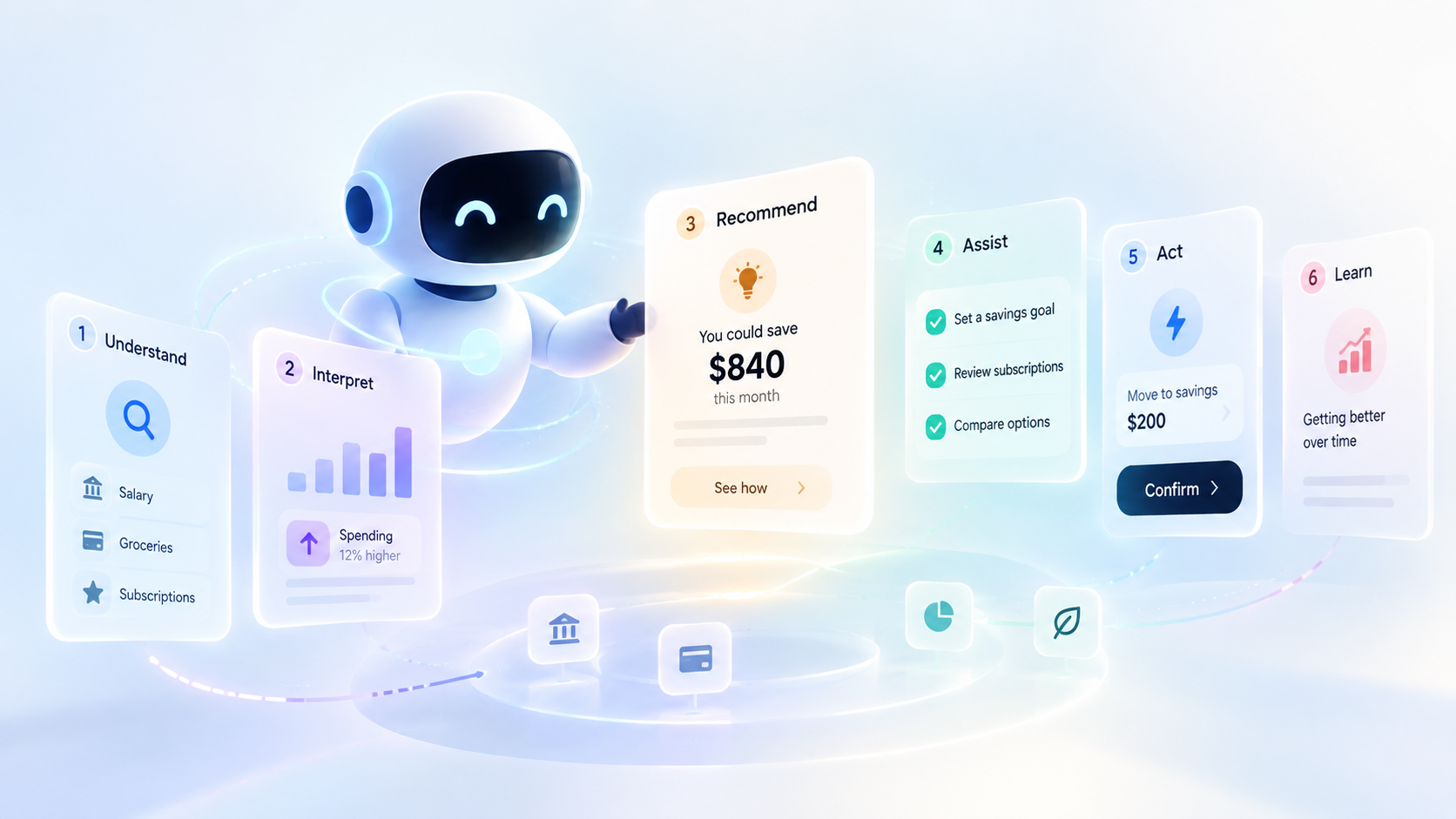
A practical way to think about AI-powered financial experiences is:
Understand → Interpret → Recommend → Assist → Act → Learn
Understand
The system understands the user’s intent, context, and relevant financial information.
Interpret
It turns raw data into meaningful patterns and insights.
Recommend
It suggests a relevant next step based on the available context.
Assist
It helps the user complete the task without unnecessarily taking over.
Act
When appropriate, the system performs the action.
Learn
The product uses feedback and behavior to improve future interactions.
Not every experience needs all six stages.
A simple transaction question might only require Understand → Interpret.
A financial recommendation might use Understand → Interpret → Recommend → Assist.
An automated workflow might extend all the way to Act.
The framework is useful because it shifts the conversation from “adding AI” to designing where intelligence belongs in the product experience.
The Future of Fintech UX Is Not More AI Everywhere
The arrival of AI creates an obvious temptation: if a product can use AI, perhaps it should.
But intelligent product design requires more restraint.
Not every problem needs a conversational interface.
Not every recommendation needs automation.
Not every piece of data needs an AI-generated insight.
And not every workflow becomes better simply because AI has been added to it.
The strongest AI-powered financial products will use intelligence where it creates meaningful value:
reducing complexity, revealing patterns, supporting decisions, and removing unnecessary effort.
The technology should remain in service of the experience.
This is also why AI in fintech should be approached as a product-design challenge, not simply a technology implementation. The opportunity lies in connecting user needs, financial workflows, business goals, data, and AI capabilities into an experience that makes sense as a whole.
From AI Strategy to Product Experience
Turning an AI opportunity into a useful financial product requires more than selecting a model or adding an AI interface.
It starts with understanding the problem, identifying where intelligence can genuinely improve the experience, testing the riskiest assumptions, designing the interaction, and defining the right balance between automation and human control.
That work connects product strategy, UX research, product design, and technology.
For fintech teams, the goal is not to make a product look more intelligent.
It is to make the product more useful because it is intelligent.
If you’re exploring an AI-powered financial product or looking to bring AI into an existing fintech experience, youx Studio can help turn the opportunity into a clear, usable, and buildable digital product experience.