A product team can know a lot about its users and still misunderstand them.
“We are designing for young professionals.”
“Our users are mostly between 25 and 35.”
“They want a simple experience.”
These statements may sound useful, but they rarely tell a product team what to design, what to prioritize, or why users behave the way they do.
This is where user personas can become valuable. A well-designed persona is not simply a fictional profile with a name, age, job title, and stock photo. It is a practical representation of a meaningful user group, grounded in research and used to help teams make better product decisions.
The role of personas in UX design has also evolved. Traditional personas often focused heavily on demographic characteristics. Modern product teams increasingly need to understand behaviors, goals, motivations, contexts, constraints, and patterns of interaction. The goal is not to make personas more detailed for the sake of detail. It is to make them more useful.
A good persona should help a team answer a practical question:
Who are we designing for, what are they trying to accomplish, and what should we do differently because we know this?
That shift—from describing users to informing decisions—is what makes personas useful in modern UX design.
What Is a User Persona in UX Design?
A user persona is a research-based representation of a group of users who share meaningful characteristics, behaviors, goals, or needs.
The person represented by a persona is fictional, but the underlying evidence should not be. Microsoft Research describes personas as a way of representing users and communicating both qualitative and quantitative information to product teams.
This distinction matters.
A persona is not supposed to be a fictional customer invented by a designer because the team needs a profile to put into a presentation. It should be a synthesis of what the team has learned about real or prospective users.
For example, consider a banking application.
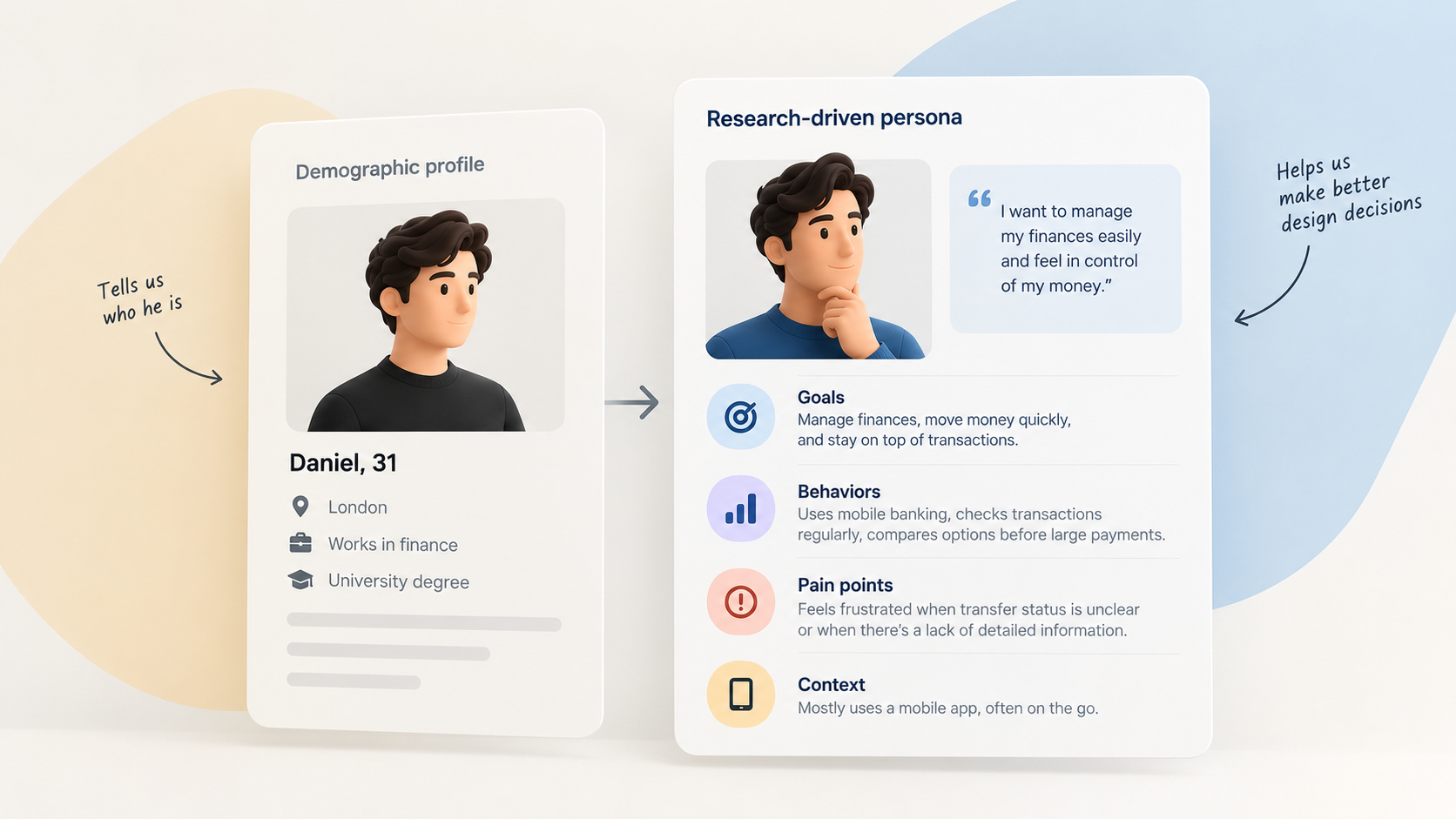
A demographic description might tell us:
Daniel, 31, lives in London, works in finance, and has a university degree.
That information may be accurate, but it does not tell us much about the experience we should design.
A more useful persona might tell us:
Daniel manages most of his finances from his phone, frequently moves money between accounts, checks transactions before making larger payments, and becomes frustrated when the status of a transfer is unclear.
Now the persona begins to influence design.
The team can ask whether transfer status is sufficiently clear, whether users can easily understand pending transactions, and whether the interface gives them enough confidence before completing a high-value action.
That is the difference between a profile and a design tool.
Why Demographics Alone Are Not Enough
Demographic information is not useless. Age, location, occupation, income, accessibility needs, and other characteristics can sometimes be important for understanding a user group.
The problem begins when demographics become the primary explanation for user behavior.
Two people of the same age, living in the same city, with similar jobs and incomes can have completely different expectations, habits, motivations, and levels of confidence when using the same product.
Imagine two 30-year-old users of an investment application.
One checks the market several times a day, understands financial terminology, and wants fast access to detailed information.
The other invests occasionally, is uncertain about financial concepts, and mainly wants reassurance that their money is being handled correctly.
Demographically, they may look almost identical.
From a product perspective, they are very different.
This is why modern UX research focuses on understanding not only who users are, but what they are trying to do, how they currently do it, what problems they encounter, and what influences their behavior. The GOV.UK Service Manual, for example, frames user research around users’ goals, current behaviors, problems, contexts, and needs rather than simply identifying popular preferences.
A useful persona therefore starts moving the conversation from:
Who is this person?
to:
How does this person behave in relation to the product?
What Should a Modern UX Persona Include?
There is no universal persona template that works for every product. The information included should depend on what the team needs to understand and what decisions the persona is expected to support.
Figma’s current guidance similarly recommends starting with research and segmentation, then deciding which background information is actually useful for the persona.
For most product design projects, several areas are particularly useful.
Goals
What is the user actually trying to accomplish?
A goal should be more meaningful than “use the app” or “buy a product.”
For a financial product, the goal might be to transfer money confidently without worrying about whether the transaction went through. For a productivity product, it might be to quickly understand what needs attention today.
Understanding the goal gives designers something concrete to design around.
Behaviors
What does the user actually do?
This is where research becomes particularly valuable.
Does the user compare several options before making a decision? Do they repeatedly return to the same feature? Do they abandon a process when it becomes complicated? Do they rely on customer support because the interface does not provide enough information?
Observed behavior is often more useful than what users say they prefer.
Motivations
Why does the user behave this way?
Two users may perform the same action for completely different reasons.
Someone may compare products because they enjoy exploring options. Another person may compare them because they are afraid of making the wrong decision.
The resulting interface may need to support both users differently.
Pain Points
Where does the current experience break down?
Pain points can include confusing terminology, unnecessary steps, lack of feedback, uncertainty, accessibility barriers, poor performance, or a mismatch between what the system does and what the user expects.
Good personas make these problems visible without turning the persona into a list of complaints.
Context
When and where is the product being used?
Context can fundamentally change an experience.
A user interacting with a desktop application at work may have time to explore. The same person using a mobile banking app while commuting may need much faster confirmation and clearer status information.
Understanding context helps teams design for real situations rather than idealized ones.
Constraints
What limits the user’s ability to complete the task?
Users may have limited time, low digital confidence, accessibility requirements, unreliable connectivity, financial constraints, or limited knowledge of the subject matter.
These constraints can be more important to the experience than demographic characteristics.
The UK Home Office’s user-centred design guidance, for example, emphasizes understanding users’ environments, needs, and contexts of use and turning research findings into actionable insights.
User Persona vs. Buyer Persona
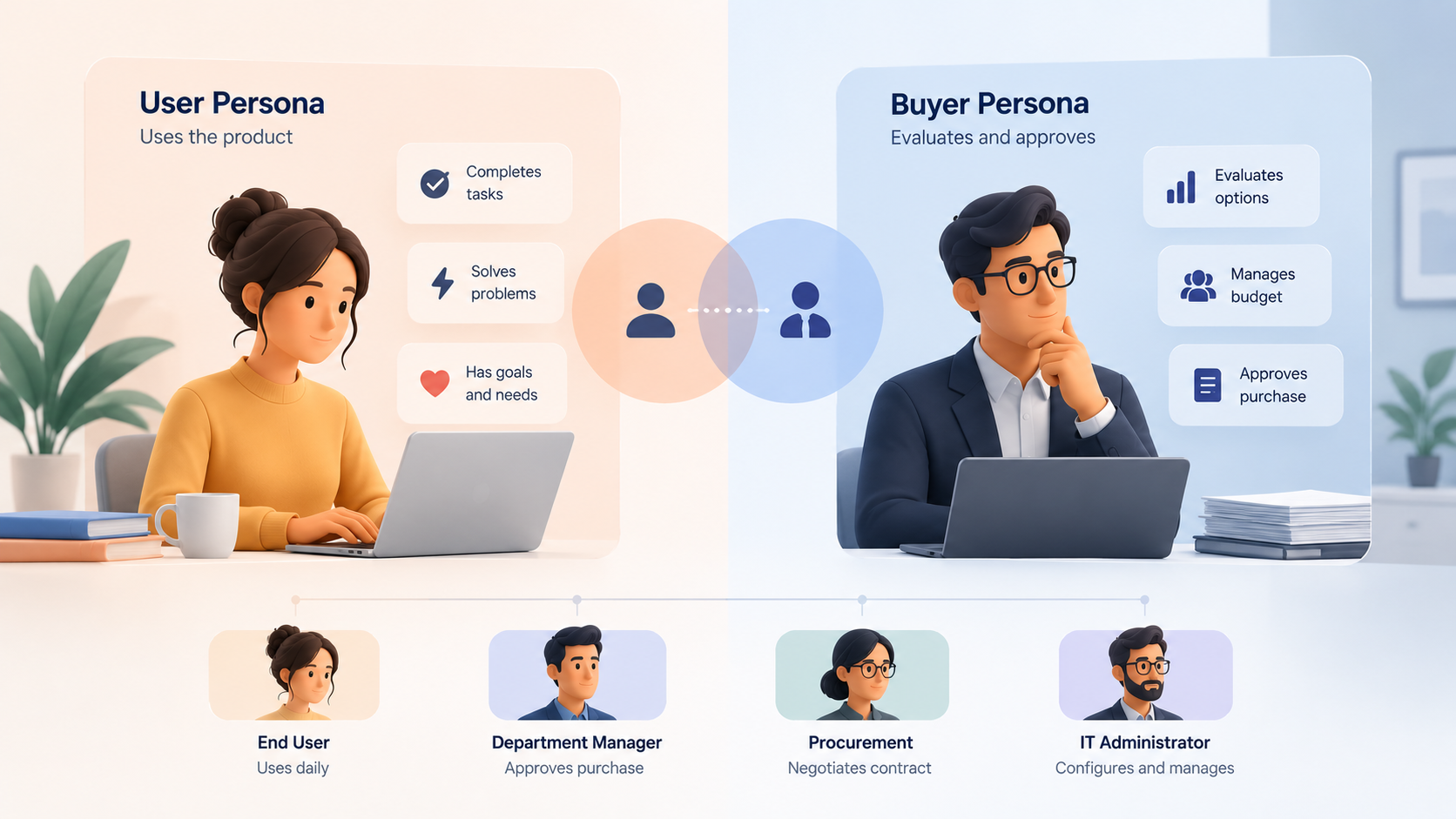
User personas and buyer personas are related, but they answer different questions.
A user persona describes the person who uses a product or service.
A buyer persona describes the person involved in evaluating, purchasing, or approving the product.
In a consumer product, these may be the same person. In a B2B product, they can be completely different.
Consider enterprise software.
A department manager may approve the purchase. A procurement team may negotiate the contract. An IT administrator may configure the platform. And individual employees may use it every day.
There is no single “user” who represents the entire experience.
This distinction matters because optimizing only for the buyer can create a product that sells well but is difficult to use. Optimizing only for the end user can overlook the requirements of the people responsible for purchasing or approving the product.
A strong product strategy recognizes the relationship between these audiences.
The goal is not necessarily to create dozens of personas. It is to understand which user groups and decision-makers have materially different needs and where those differences affect the product experience.
How to Build a User Persona From Real Research
The quality of a persona is largely determined before the persona itself is created.
If the underlying research is weak, the persona will simply give assumptions a professional-looking format.
A better process starts with evidence.
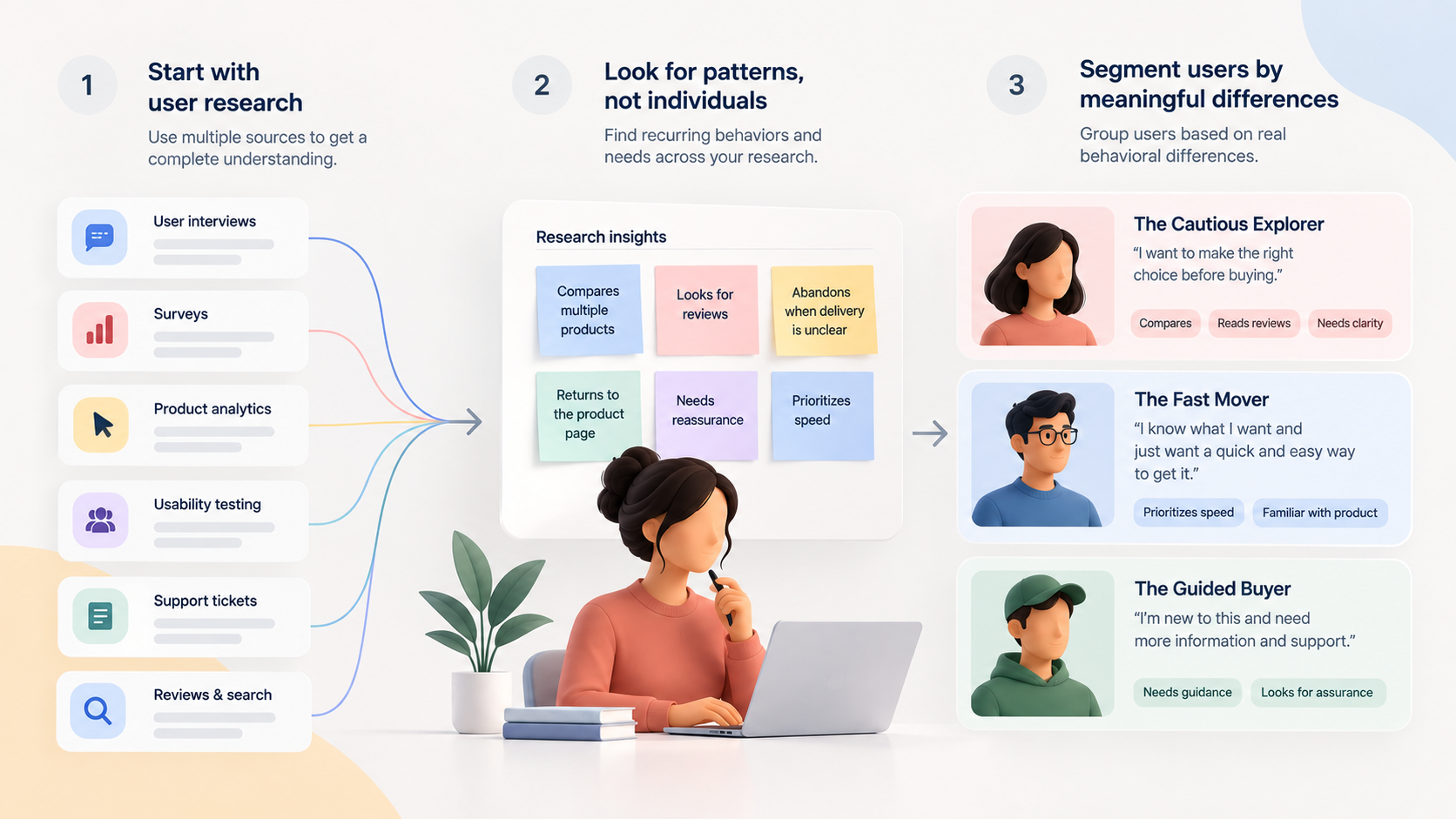
Start With User Research
Research can combine qualitative and quantitative methods.
Interviews can reveal motivations, frustrations, expectations, and mental models. Surveys can help identify broader patterns. Analytics can show what people actually do inside a product. Usability testing can expose problems that users may not be able to articulate themselves.
Support tickets, search behavior, customer feedback, product reviews, and existing research can also reveal recurring issues.
The important principle is not to depend on one source.
The GOV.UK Service Manual recommends using a range of research methods and existing evidence, including analytics, support information, observation, interviews, and usability testing, to develop a more complete understanding of users.
Look for Patterns, Not Interesting Individuals
One of the biggest mistakes in persona development is building a persona around an interesting interview participant.
A persona is not a biography of the most memorable user.
After research, the team should look for recurring patterns.
For example, imagine interviewing ten users of an e-commerce product and discovering that several of them independently:
- compare multiple products before buying
- look for reviews before trusting a product
- abandon the process when delivery information is unclear
- return to the product page several times before purchasing
Those patterns may represent a meaningful behavioral segment.
The persona should capture the pattern—not simply reproduce one participant’s story.
Segment Users by Meaningful Differences
Segmentation is where research starts becoming useful for design.
Instead of creating groups such as:
Users aged 18–24
Users aged 25–34
Users aged 35–44
consider whether there are behavioral differences that actually affect the experience.
For example:
Users who need reassurance before making a decision.
Users who prioritize speed and already understand the product.
Users who need guidance because they are unfamiliar with the category.
These groups can lead to different design decisions.
From Persona to Design Decision
This is arguably the most important part of the entire process.
A persona has little value if it exists only as a document, slide, or workshop artifact.
Its real value appears when it changes what the team decides to build.
Imagine a persona describing a user who frequently completes financial tasks under time pressure and is highly sensitive to uncertainty.
That insight might lead to decisions such as clearer transaction states, more visible confirmation, fewer unnecessary steps, and stronger feedback after an action.
The persona itself does not solve the design problem.
It helps the team understand which problem deserves attention and why.
This creates a useful chain:
Research → Insight → Persona → Design Decision → Validation
The persona sits in the middle of the process. It translates research into a form that product managers, designers, engineers, and other stakeholders can use when discussing decisions.
A Simple Example of a Research-Driven Persona
Consider a subscription-based productivity product.
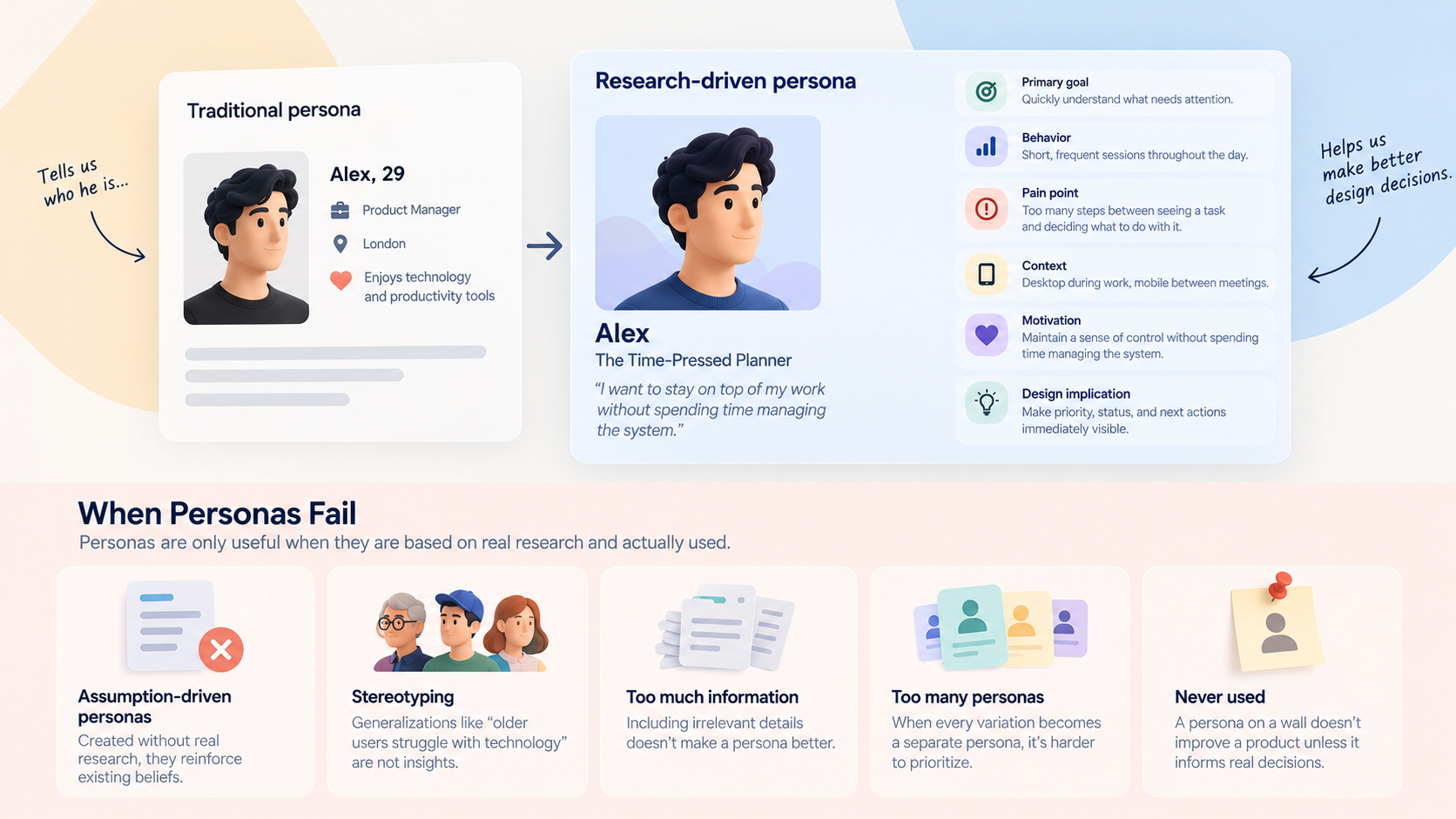
A traditional persona might look like this:
Alex, 29
Product Manager
Lives in London
Enjoys technology and productivity tools
It tells the team who Alex supposedly is, but very little about what the team should design.
A research-driven version might look like this:
Alex — The Time-Pressed Planner
Alex uses the product between meetings and often has only a few minutes to organize tasks. They tend to prioritize quickly, revisit unfinished work later, and become frustrated when the interface requires too much manual organization.
Primary goal: Quickly understand what needs attention.
Behavior: Short, frequent sessions throughout the day.
Pain point: Too many steps between seeing a task and deciding what to do with it.
Context: Desktop during work, mobile between meetings.
Motivation: Maintain a sense of control without spending time managing the system.
Design implication: Make priority, status, and next actions immediately visible.
The second version is more useful because every element can potentially influence a product decision.
That is what a good UX persona should do.
When Personas Fail
Personas are not automatically useful simply because a team has created them.
They can fail in several ways.
The first is assumption-driven personas.
If the team creates a persona before conducting meaningful research, the document can simply reinforce what everyone already believes about the audience.
The second is stereotyping.
A persona that says “older users struggle with technology” or “young users want everything fast” is not research. It is a stereotype presented as insight.
The third problem is too much information.
A persona does not become better because it contains twenty demographic attributes, a favorite brand, hobbies, a fictional family history, and a paragraph about what the person does on weekends.
If an attribute does not help the team understand behavior or make a product decision, it may not belong in the persona.
The fourth problem is too many personas.
When every possible user becomes a separate persona, the tool stops helping the team prioritize. A useful set of personas should represent meaningful differences, not every variation within the customer base.
Finally, personas can fail when they are never used.
A beautifully designed persona pinned to a wall does not improve a product by itself.
It needs to appear in conversations about user flows, features, prototypes, content, accessibility, prioritization, and usability testing.
Personas Should Evolve With the Product
A persona is not a permanent description of a market.
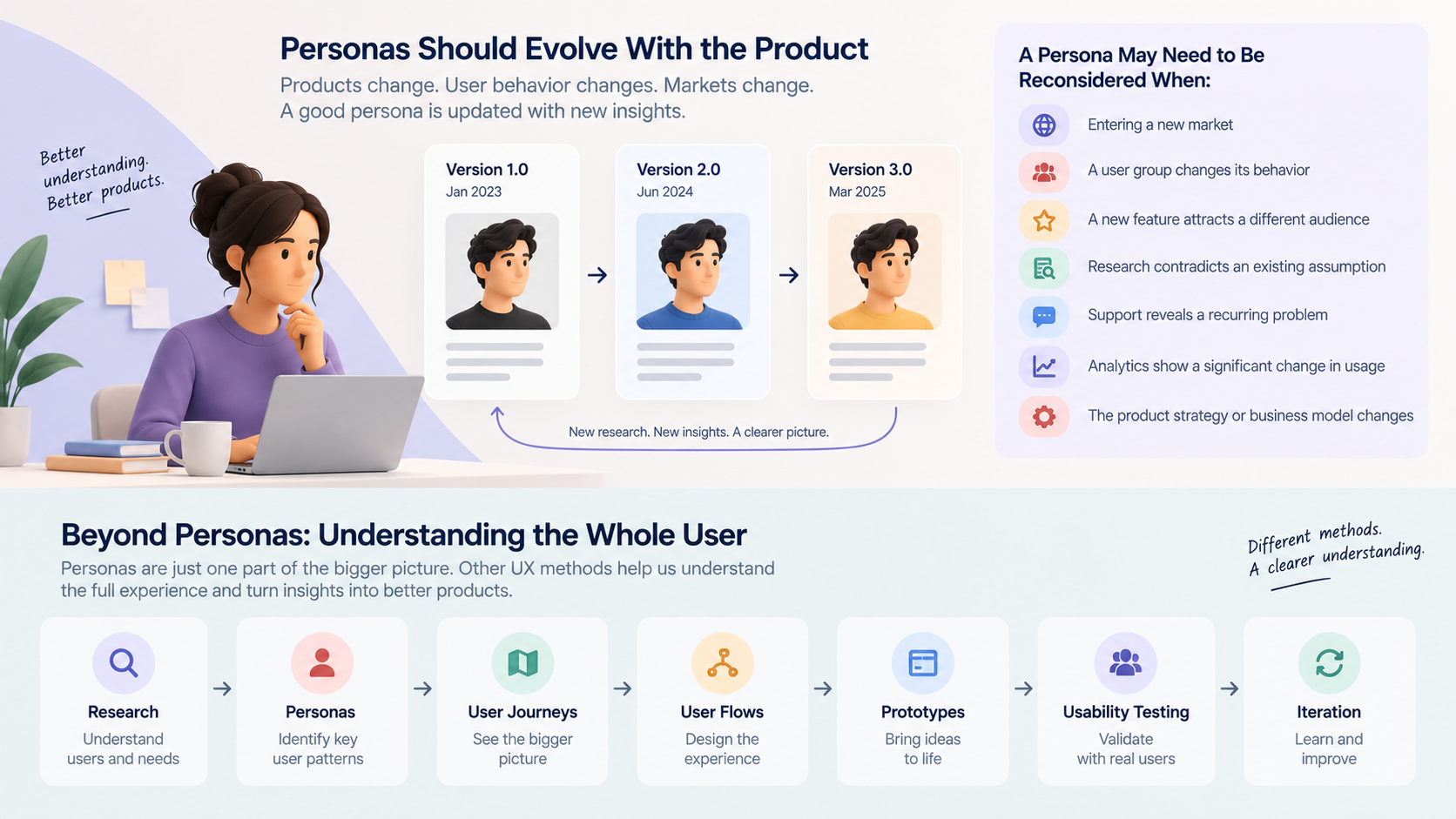
Products change. User behavior changes. Markets change. New features attract different audiences. Business models evolve. And research can challenge assumptions that once seemed obvious.
That means persona development should be iterative.
A persona may need to be reconsidered when:
- a product enters a new market
- a major user group changes its behavior
- a new feature attracts a different audience
- research contradicts an existing assumption
- customer support reveals a recurring problem
- analytics show a significant change in usage patterns
- the product strategy or business model changes
The goal is not to constantly redesign the persona document.
The goal is to keep the team’s understanding of users aligned with reality.
Beyond Personas: Understanding the Whole User
Personas are useful, but they are not a complete representation of the user experience.
A persona can help answer who the team is designing for and what patterns matter. Other UX methods help answer different questions.
A journey map can reveal what happens across an end-to-end experience. User flows can show how someone moves through a product. Usability testing can reveal whether a proposed solution actually works. Analytics can show behavior at scale.
This is why personas work best as part of a broader product design process rather than as a standalone deliverable.
A useful sequence might look like:
Research → Personas → User Journeys → User Flows → Prototypes → Usability Testing → Iteration
The exact process will vary by product, but the underlying idea remains the same: research should inform decisions, and decisions should be tested against real user behavior.
Are User Personas Still Relevant?
Yes—but the way teams use them matters.
The criticism of traditional personas is often not really a criticism of personas themselves. It is a criticism of personas that reduce complex users to demographic stereotypes or fictional stories.
Modern product teams have access to more behavioral data, continuous research, analytics, and usability feedback than ever before. That creates an opportunity to make personas more grounded and more useful.
At the same time, personas should not become an excuse to simplify users too aggressively.
This is an important consideration.
The purpose of a persona is not to claim that every user in a segment behaves exactly the same way. It is to give a product team a useful representation of a meaningful pattern without losing sight of the diversity behind it.
In other words, a persona is a lens—not the entire picture.
From User Understanding to Better Products
The strongest personas do something simple but important: they make research usable.
They help teams move from vague statements about an audience to a clearer understanding of goals, behaviors, motivations, constraints, and context.
More importantly, they connect that understanding to action.
A persona should make a designer question a user flow, help a product manager reconsider a feature, give an engineer context for an edge case, or help a team decide what not to build.
That is why the evolution of user personas is not really about adding more information to a profile.
It is about making the information more relevant to product decisions.
A useful persona does not try to describe everything about a person.
It captures the patterns that matter.
And when those patterns come from real research, are continually validated, and are connected to actual design decisions, personas can remain a powerful part of modern UX and product design.
A persona is not the user. It is a tool that helps a product team make better decisions for real users.